Book route
The Odyssey Book-by-Book Summary
The short answer
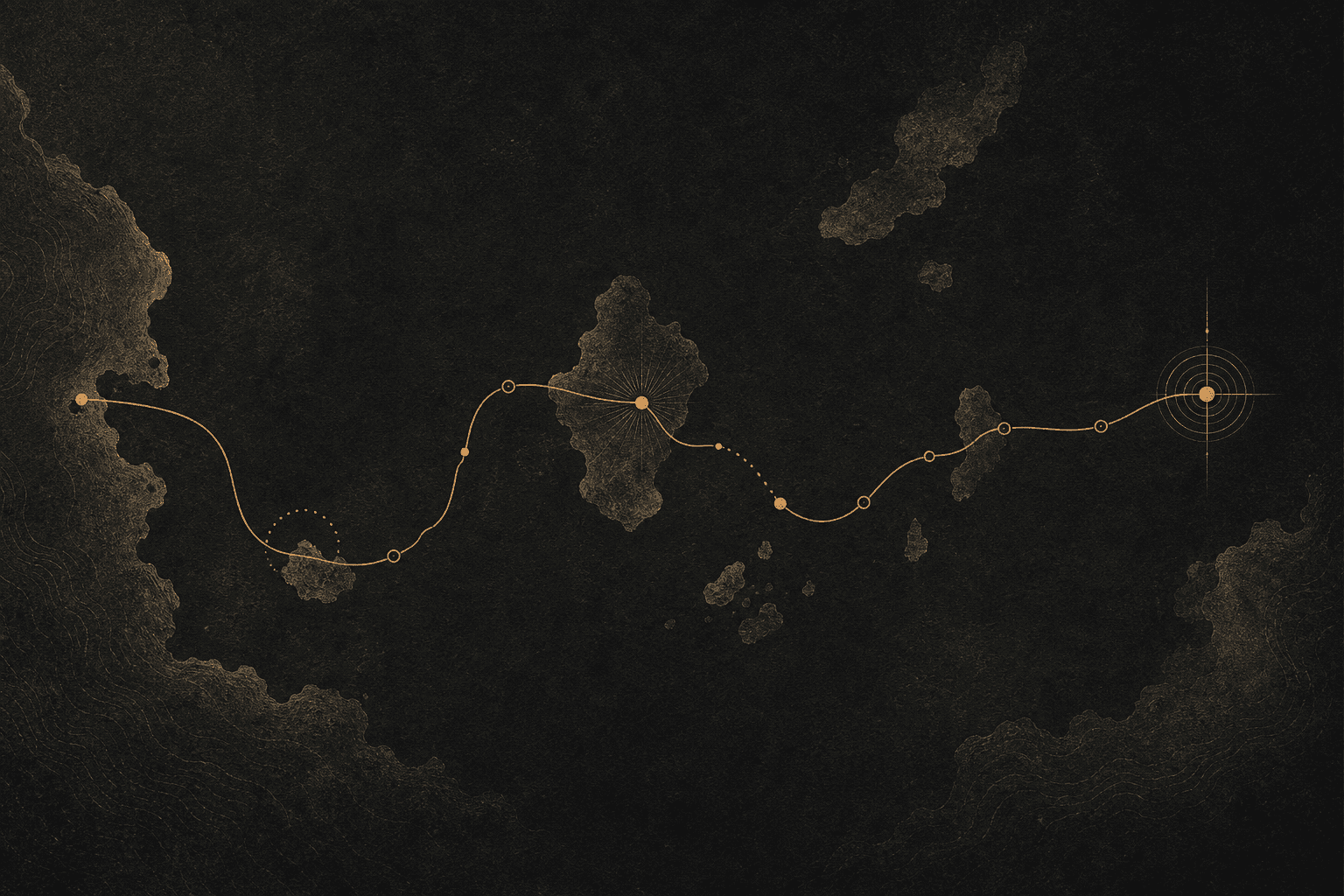
The Odyssey has 24 books: Books 1-4 follow Telemachus in Ithaca and abroad, Books 5-12 bring Odysseus from Calypso through the famous wanderings, and Books 13-24 return him to Ithaca in disguise. The trick is that the adventures are a flashback; the poem's real destination is recognition at home.
Twenty-four books, one return.
The poem becomes readable when the three movements are visible: son, wanderer, return.
Updated July 6, 2026
Five things to hold onto
- Books 1-4 are the Telemachy: the son searches for news of the father.
- Books 5-8 move Odysseus from Calypso's island to the Phaeacian court.
- Books 9-12 are the famous wanderings, told by Odysseus as a flashback.
- Books 13-24 are the return: disguise, testing, violence, recognition, and uneasy peace.
- Half the poem happens after Ithaca is reached, because homecoming is the test.
Complete digital edition
Read the whole poem without losing the route.
Designed PDF and EPUB, book-by-book guidance, 120+ notes, five essays, the journey map, and character cards in one download.
The fastest way to understand the Odyssey is not to memorize every island. It is to see the architecture. Homer gives the poem three movements: a son without a father, a man delayed from home, and a return that has to be tested before it can be believed.
If you want the same architecture in a compressed route, the best reading plan for Homer's Odyssey turns these movements into a practical schedule.
Open individual summaries as you need them: Book 1 for Athena, Telemachus, and the crisis in Ithaca; Book 9 for the Cyclops and the boast that brings Poseidon's curse; Book 12 for the Sirens, Scylla, Charybdis, and the cattle of the Sun.
Books 1-4: Telemachus Before Odysseus
The poem begins in Ithaca, not at sea. Odysseus is absent. Suitors occupy his hall, consume his estate, and press Penelope to remarry. Athena appears in disguise and pushes Telemachus to act like the son of Odysseus: call an assembly, confront the suitors, and sail to Pylos and Sparta for news.
This opening is often where first-time readers get impatient. It is also where the poem quietly tells you what kind of story it is. Home is not waiting untouched. Absence has consequences.
That is the reason Telemachus matters: the poem starts with the son because the father's absence has already changed the house.
Books 5-8: Odysseus Appears
Only in Book 5 do we meet Odysseus himself: not in glory, but weeping on Calypso's shore. She offers immortality; he wants home. After a wreck, he reaches Scheria, land of the Phaeacians, where Nausicaa and her parents receive him. At a feast, the bard Demodocus sings of Troy, and Odysseus breaks down.
The hero has returned to narrative before he returns to Ithaca. He must tell the story of what happened to him.
Books 9-12: The Wanderings
These four books contain the episodes everyone remembers: the Cicones, Lotus-eaters, Cyclops, Aeolus, Laestrygonians, Circe, the underworld, Sirens, Scylla and Charybdis, and the cattle of the Sun. But structurally they are not the main present-tense plot. They are Odysseus' own account at the Phaeacian court.
For a visual version of that movement, the Odysseus journey map helps keep the stops connected to the story rather than treating them as trivia.
That matters. We are hearing a survivor shape his losses into a story.
Books 13-20: Home in Disguise
The Phaeacians bring Odysseus to Ithaca while he sleeps. He wakes on his own island and does not recognize it. Athena disguises him as a beggar; he meets the swineherd Eumaeus, reveals himself to Telemachus, enters his own hall, and is insulted by the men who have eaten his house.
The return is slow because recognition must be earned. Son, servants, wife, and enemies all have to be tested.
That slow return is why the Odyssey as a story of homecoming keeps insisting that arrival is not the same thing as being home.
Books 21-24: Bow, Bed, Orchard
Penelope sets the bow contest. Odysseus strings the bow, reveals himself, and kills the suitors. But the poem does not end with violence. It moves to the bed test in Book 23, where Penelope proves him by the secret of their immovable marriage bed, and then to Laertes in Book 24, where father and son are restored in the orchard.
The Home Pack ($19) includes the full book-by-book route, printable reading plans, character cards, and our digital Companion Edition with notes.
Classics RediscoveredThe Odyssey Companion
We make the classics readable for modern adults. Independent and unofficial — every quotation is checkable by book number against Homer's text. Questions? hello@odysseycompanion.com
Questions people ask
Which books of the Odyssey are the most important?
For a fast first read, focus on Books 1, 5, 9-12, 16-17, 19, and 21-23. That gives you the crisis at home, Calypso, the wanderings, father and son, the scar, the bow, and the bed test.
Why does the Odyssey start with Telemachus?
Because the poem is not only about a man traveling home. It is also about the damage his absence has done to the house, the son, and the kingdom.
Keep reading
The Odyssey Explained in 15 Minutes
The whole story of Homer's Odyssey in a 15-minute read: the three-part structure, the wanderings told in flashback, the return, and the ending explained.
Read →
Odysseus' Journey Map: Every Stop from Troy to Ithaca
Every stop on Odysseus' ten-year route from Troy to Ithaca — Cyclops, Circe, Sirens, Calypso — what happens at each one, and what it costs him.
Read →
Can You Read The Odyssey Before July 17, 2026?
Yes: The Odyssey takes about 10-14 hours to read — before or after Christopher Nolan's movie. Honest math, a 7-day plan, and which books matter most.
Read →
Why Telemachus Matters More Than You Think
Telemachus in the Odyssey, explained: why Homer begins with Odysseus' son, and how the absent father shapes the whole poem.
Read →
Source notes
- Homer, Odyssey, Books 1-24, Samuel Butler translation
- Uncontroversial Homer facts: 24-book structure, oral-formulaic tradition, traditionally dated to the 8th century BCE