The story
The Odyssey Explained in 15 Minutes
The short answer
The Odyssey, traditionally dated to the 8th century BCE, tells how Odysseus takes ten years to return home from the Trojan War. Homer splits the story in three: his son Telemachus searches for news, Odysseus recounts his famous wanderings in flashback at a foreign court, and the final third is a covert homecoming — disguise, recognition, and a violent reckoning with the suitors occupying his house.
A man can win a war and still lose the way home.
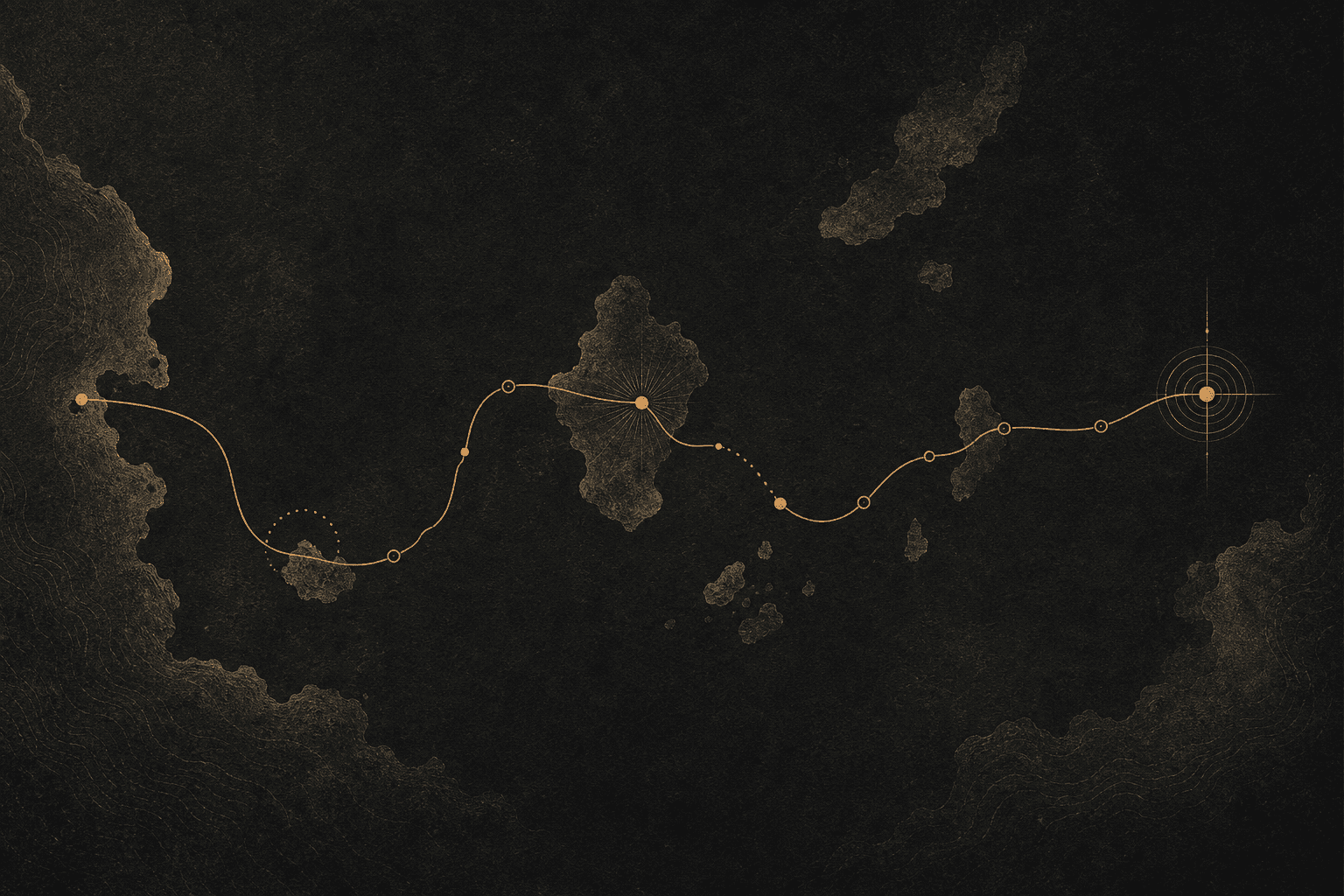
Start with the plot, then watch the adventure turn into a map of return.
Updated July 21, 2026
Four things to hold onto
- The poem has three movements: the son's search (Books 1–4), the wanderings (Books 5–12), and the return to Ithaca (Books 13–24)
- The famous adventures — Cyclops, Circe, the Sirens — are a flashback: a first-person story Odysseus tells at the Phaeacian court
- Half the poem happens on Ithaca: the homecoming is the story, not the epilogue
- You don't need the Iliad first — the Odyssey retells the war background it needs through its own characters
Most people inherit the Odyssey in fragments — a one-eyed giant, a song that kills sailors, a man tied to a mast. The fragments are real, but they suggest a loose bag of monster stories. The actual poem is one of the most deliberately built stories in Western literature, and once you see its shape — three movements, hinged on one long flashback — everything snaps into place.
What the poem actually is
The Odyssey is an epic poem traditionally dated to the 8th century BCE, composed in an oral tradition of performing poets: 24 books, roughly 12,000 lines. It shares a world with the Iliad — same war, some of the same survivors — but it is not a war story. The war is over. This is a poem about what comes after: the ten years it takes one man, Odysseus of Ithaca, to reach his wife and son, and what he finds when he arrives. The Greeks had a word for this kind of story — nostos, homecoming — and the whole poem lives inside it.
Samuel Butler's translation opens like this:
Tell me, O Muse, of that ingenious hero who travelled far and wide after he had sacked the famous town of Troy.
The first thing the poem calls its hero is not strong or brave but ingenious — the Greek is polytropos, "of many turns"; Emily Wilson's 2017 translation famously rendered it "complicated." A man who survives by turning: his ships, his stories, himself.
When the story opens, Odysseus has been gone twenty years: ten at Troy, ten lost at sea. His son Telemachus, an infant when he sailed, is grown. His wife Penelope is besieged in her own house by 108 suitors who eat through the estate and press her to remarry. Odysseus himself is nowhere in sight — the first structural surprise.
The shape: Homer starts near the end
The Odyssey does not begin at Troy and march forward. It begins in the story's final year, with nearly everything already lost: every ship gone, every companion dead. Odysseus has spent seven years held on the island of the goddess Calypso — comfortable, offered immortality, and weeping on the shore every day. The famous adventures all happened years earlier. Homer will deliver them — but on his own terms, across three movements.
Movement one: the son (Books 1–4)
For four full books, the hero never appears. Homer opens on Ithaca, on the wreckage of Odysseus' household, and on Telemachus — a young man raised on a rumor of a father. The goddess Athena prods him out of paralysis: confront the suitors, sail for news. He visits two veterans of Troy — old Nestor at Pylos, then Menelaus and Helen at Sparta — and hears, for the first time as an adult, who his father actually was — and the first report that he may be alive.
Scholars call this opening the Telemachy. It shows what twenty years of absence cost before we ever meet the absent man — so when Odysseus finally appears, we know exactly what is at stake.
Movement two: the wanderings, told at a dinner table (Books 5–12)
Book 5 finally reaches Odysseus. Zeus sends word; Calypso must let him go. He builds a raft and sails seventeen days — and on the eighteenth, within sight of land, Poseidon, who bears an old and personal grudge, smashes it to pieces. Odysseus washes ashore, half-drowned, in Scheria, land of the Phaeacians. The princess Nausicaa finds him; he is received at the palace as an unnamed guest. Then the court bard sings about Troy, the stranger weeps, and the king asks the question the whole poem has been circling: who are you?
Books 9 through 12 are his answer. Everything you think of as "the Odyssey" arrives as a first-person story, told by Odysseus himself, in a single night, at a foreign table. In order: the raid on the Cicones; the Lotus-eaters, whose fruit dissolves the desire to go home; the Cyclops Polyphemus, blinded in his own cave — the act that earns Poseidon's anger; Aeolus' bag of winds, opened by the curious crew within sight of Ithaca; the Laestrygonian giants, who destroy eleven of the twelve ships; a year with the enchantress Circe; the voyage to the dead in Book 11, where the prophet Tiresias maps the road home and Odysseus meets his own mother, who died grieving for him; the Sirens; the double trap of Scylla and Charybdis; and finally the cattle of the Sun, the starving crew's fatal transgression: Zeus destroys the ship and every man aboard. Odysseus alone survives, drifting to Calypso's island. The flashback ends exactly where the poem began.
Notice how modern this is. Homer buries the "action movie" in the middle of the poem, as memory — a survivor's account, delivered to strangers, by a narrator with every reason to perform. Long before cinema discovered the flashback, the frame story, and the narrator you can't entirely verify, this poem was built from all three. The adventures matter; the telling matters more. A man is saying who he is, out loud, to an audience, before he goes home to prove it.
Movement three: the return (Books 13–24)
The fact that most surprises first-time readers: the wanderings occupy eight books. The homecoming takes twelve. Half the Odyssey happens on Ithaca, because Homer does not treat return as the epilogue to adventure. Return is the adventure.
The Phaeacians land Odysseus, asleep, on his own shore. Athena disguises him as an aged beggar — necessary, because his house is now enemy ground. What follows is a slow, controlled sequence of recognitions. His son first: Telemachus, in the swineherd's hut, meets his father for the first time in living memory (Book 16). Then his dog: Argos, old and abandoned, knows his master through the disguise and dies a moment later (Book 17). Then his old nurse: Eurycleia, washing the beggar's feet, touches the boar-tusk scar on his thigh and nearly cries out (Book 19). Penelope, who trusts no one and no story, announces a contest: she will marry the man who can string Odysseus' great bow and shoot an arrow through twelve axes. Every suitor fails. The beggar asks for a turn.
Book 22 is the reckoning. The doors are barred, the disguise drops, and Odysseus — with Telemachus and two loyal herdsmen — kills the suitors — all of them. It is sudden, methodical, shocking, and meant to be.
The ending: a bed, a father, an imposed peace
Two recognitions remain, and they are the summit of the poem. Penelope tests the man who claims to be her husband: she orders their marriage bed moved. He erupts — impossible. He built that bed himself around the trunk of a living olive tree; it cannot be moved without cutting it down. Only the two of them know this, and it is the proof she required (Book 23). Then Odysseus finds his father Laertes grieving in his orchard and proves himself by naming the trees his father gave him as a boy, counted and remembered across twenty years (Book 24).
The final scene is abrupt: the suitors' families march for revenge, and Athena, backed by Zeus, commands the cycle of blood to stop. Peace is imposed rather than earned — readers have argued about that ending since antiquity.
The discomfort feels designed. The poem does not pretend a man can be gone twenty years and come back clean, or that a house can be reclaimed without cost. Homecoming, in the Odyssey, is not a soft landing — it is the hardest fight in the story, and even its resolution needs a god to hold it in place.
Where to go from here
If you want the whole route now, get the Home Pack: the complete digital poem, guide, map, cards, notes, reading plans, and essays for reading the Odyssey as an adult homecoming story.
The poem is more readable than its reputation. See Best Odyssey Translation for First-Time Readers for an edition that won't fight you, or Can You Read the Odyssey Before July 17? for a realistic plan. To go deeper rather than faster, start with Penelope, the poem's other great strategist, or with homecoming, fatherhood, and return — the themes the whole story is secretly about.
Classics RediscoveredThe Odyssey Companion
We make the classics readable for modern adults. Independent and unofficial — every quotation is checkable by book number against Homer's text. Questions? hello@odysseycompanion.com
Free reading preview
Take the route, names, and recognition scenes with you.
Get the one-evening guide and a designed preview from the complete edition. Useful on its own; clear about where to go next.
Questions people ask
Is the Odyssey hard to read?
Less than its reputation suggests. It's a plot-driven story — storms, monsters, disguises, a rigged contest — and good modern translations read fluently. The real obstacles are unfamiliar names and the nonlinear structure, and knowing the three-movement shape in advance removes most of the difficulty.
How long does it take to read the Odyssey?
The poem runs 24 books and roughly 12,000 lines — about the length of a mid-sized novel in translation. Most readers finish in 10 to 14 hours. At an hour a day that's about two weeks; a focused week is enough.
Do I need to read the Iliad first?
No. The Odyssey stands on its own. The Trojan War backstory it needs is retold inside the poem — Nestor, Menelaus, and Helen share their memories of the war, and a court bard sings the story of the wooden horse in Book 8.
Keep reading
Why Odysseus Left Calypso — and Refused to Be a God
Why does Odysseus leave Calypso in the Odyssey? Book 5, in Homer's words: he refuses immortality for a mortal home and wife — and how the 2026 film reworks it.
Read →
The Cyclops and the 'Nobody' Trick, Explained
How Odysseus outwits the Cyclops in Book 9 of the Odyssey: the 'Noman' trick in Homer's own words — and the famous pun the 2026 film drops.
Read →
The Odyssey Explained in 60 Seconds
A fast, adult explanation of Homer's Odyssey: the plot, structure, characters, and why the story is really about return.
Read →
The Odyssey 2026 Film: What to Know Before Watching
Unofficial poem-first guide to Christopher Nolan's The Odyssey (2026), now in theaters: Homer's story, the characters, and the ending the film rewrote.
Read →
Who Is Who in The Odyssey?
A clear guide to the main characters in Homer's Odyssey: Odysseus, Penelope, Telemachus, Athena, Poseidon, Circe, Calypso, and more.
Read →
Which Parts of The Odyssey Matter Most Before the Film?
The essential Odyssey books and scenes to know before the 2026 film: Telemachus, Calypso, Cyclops, Circe, underworld, Sirens, bow, and bed.
Read →
The Best Reading Plan for Homer's Odyssey
A practical Odyssey reading plan for busy adults: what to read first, what to skim, and how to finish without losing the deeper story.
Read →
Odysseus' Journey Map: Every Stop from Troy to Ithaca
Every stop on Odysseus' ten-year route from Troy to Ithaca — Cyclops, Circe, Sirens, Calypso — what happens at each one, and what it costs him.
Read →
Best Odyssey Translation for First-Time Readers
Wilson, Fagles, Fitzgerald, Lattimore, or Butler? An honest comparison of the five major Odyssey translations — and which to read for the 2026 film.
Read →
Who Is Penelope? The Odyssey's Other Strategist
Penelope in the Odyssey, explained: the weaving trick, the bow contest, and the bed test — why Homer's queen of Ithaca is a strategist, not a waiting wife.
Read →
The Odyssey Book-by-Book Summary
A clear 24-book summary of Homer's Odyssey: Telemachus, Odysseus' wanderings, the return to Ithaca, and the ending.
Read →
The Odyssey Themes Explained
The major themes of the Odyssey explained for adult readers: homecoming, identity, temptation, hospitality, fate, and recognition.
Read →
Is The Odyssey Hard to Read?
Is Homer's Odyssey difficult for beginners? A practical guide to what slows readers down and how to choose a readable path.
Read →
Source notes
- Homer, Odyssey, Book 1 and Books 9–12 (the wanderings), Samuel Butler translation
- Homer, Odyssey, Books 13–24 (the return and recognitions), Samuel Butler translation
- Uncontroversial Homer facts: composed ~8th c. BCE, 24 books, ~12,000 lines, oral-formulaic tradition, sequel-in-setting to the Iliad
- Joel Christensen (Homer scholar) — CUNY interview, April 2026: the Odyssey 'changes radically depending on your role in life'; nostos; identity through recognition
- Emily Wilson, The Odyssey (W. W. Norton, 2017)
- Universal Pictures official site: The Odyssey in theaters July 17, 2026; shot with IMAX film cameras