Fast orientation
The Odyssey Explained in 60 Seconds
The short answer
The Odyssey is the story of Odysseus trying to return to Ithaca after the Trojan War. His wife Penelope holds the house against suitors, his son Telemachus searches for news, and Odysseus survives temptations, monsters, and a god's anger. The famous journey is only half the point: the poem is about whether return is still possible.
The plot is simple. The return is not.
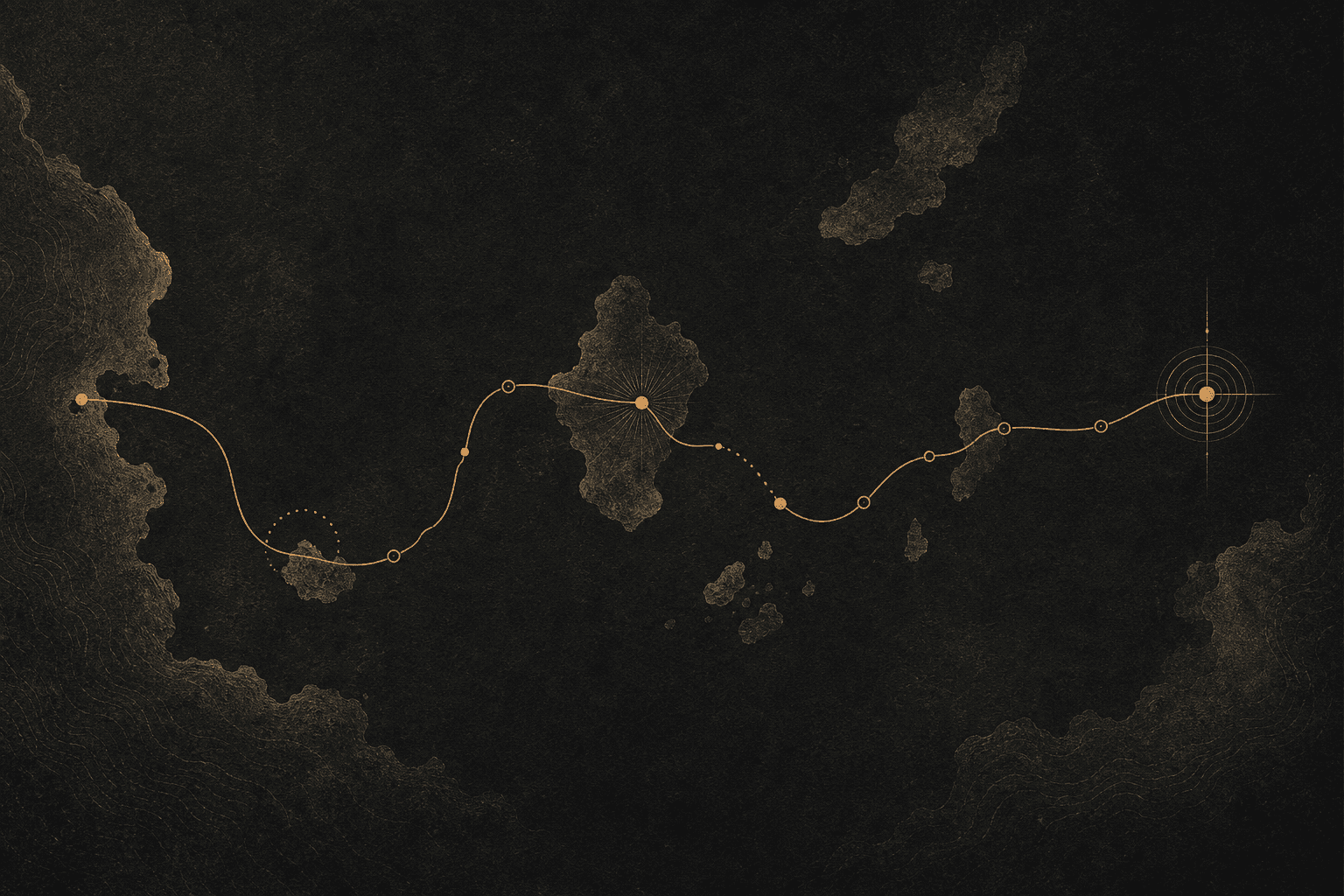
War ends, the house waits, the wanderer tells his story, and home must recognize him again.
Updated July 7, 2026
Five things to hold onto
- Odysseus spends ten years trying to return after ten years at Troy.
- The poem begins in Ithaca, with Penelope and Telemachus under pressure.
- The famous wanderings are told as a flashback.
- Odysseus reaches Ithaca in Book 13, but the hardest return begins there.
- Recognition, not travel, is the poem's deepest engine.
Here is the quick version.
Odysseus has helped win the Trojan War, but victory does not get him home. Ten years later he is still missing. In Ithaca, his wife Penelope is surrounded by suitors who are eating through the household and pressuring her to remarry. His son Telemachus is old enough to feel the absence but not yet powerful enough to solve it.
That is where the poem starts: not with adventure, but with a house under pressure.
Then Odysseus appears, trapped on Calypso's island. He leaves, reaches the Phaeacians, and tells the story of his wanderings: the Lotus-Eaters, the Cyclops, Aeolus, the Laestrygonians, Circe, the underworld, the Sirens, Scylla and Charybdis, and the cattle of the Sun.
Those are the famous episodes. But structurally, they are memory. Odysseus is not just surviving them; he is narrating them.
In Book 13 he reaches Ithaca. Many modern summaries would end there. Homer does not. Odysseus returns in disguise, tests the house, reveals himself to Telemachus, is recognized by his old nurse through a scar, strings the bow, kills the suitors, and is finally tested by Penelope through the secret of their bed.
The poem ends only after he meets his father, Laertes, and the cycle of revenge is halted.
So the cleanest 60-second explanation is this: the Odyssey is not only about getting home. It is about whether home, after war and time and disguise, can still know you.
Start with the fuller Odyssey explained, then use the journey map and reading plan to keep the structure in your head. When you want to keep the full guide and book together, use the Home Pack.
Classics RediscoveredThe Odyssey Companion
We make the classics readable for modern adults. Independent and unofficial — every quotation is checkable by book number against Homer's text. Questions? hello@odysseycompanion.com
Free reading preview
Take the route, names, and recognition scenes with you.
Get the one-evening guide and a designed preview from the complete edition. Useful on its own; clear about where to go next.
Questions people ask
What is the Odyssey about in one sentence?
It is about a man trying to return home after war and discovering that arrival is not the same thing as being known again.
Is the Odyssey mainly about monsters?
No. The monsters are famous, but the poem spends half its length on Ithaca, where disguise, recognition, and restoration matter most.
Keep reading
The Odyssey Explained in 15 Minutes
The whole story of Homer's Odyssey in a 15-minute read: the three-part structure, the wanderings told in flashback, the return, and the ending explained.
Read →
Who Is Who in The Odyssey?
A clear guide to the main characters in Homer's Odyssey: Odysseus, Penelope, Telemachus, Athena, Poseidon, Circe, Calypso, and more.
Read →
Odysseus' Journey Map: Every Stop from Troy to Ithaca
Every stop on Odysseus' ten-year route from Troy to Ithaca — Cyclops, Circe, Sirens, Calypso — what happens at each one, and what it costs him.
Read →
The Best Reading Plan for Homer's Odyssey
A practical Odyssey reading plan for busy adults: what to read first, what to skim, and how to finish without losing the deeper story.
Read →
The Odyssey as a Story of Homecoming, Fatherhood, and Return
An unofficial guide to nostos in Homer's Odyssey: homecoming, fatherhood, and return — and the recognition scenes that restore Odysseus's name.
Read →
Source notes
- Homer, Odyssey, Books 1-24, Samuel Butler translation
- Homer, Odyssey, Books 9-12 (wanderings) and 13-24 (homecoming)