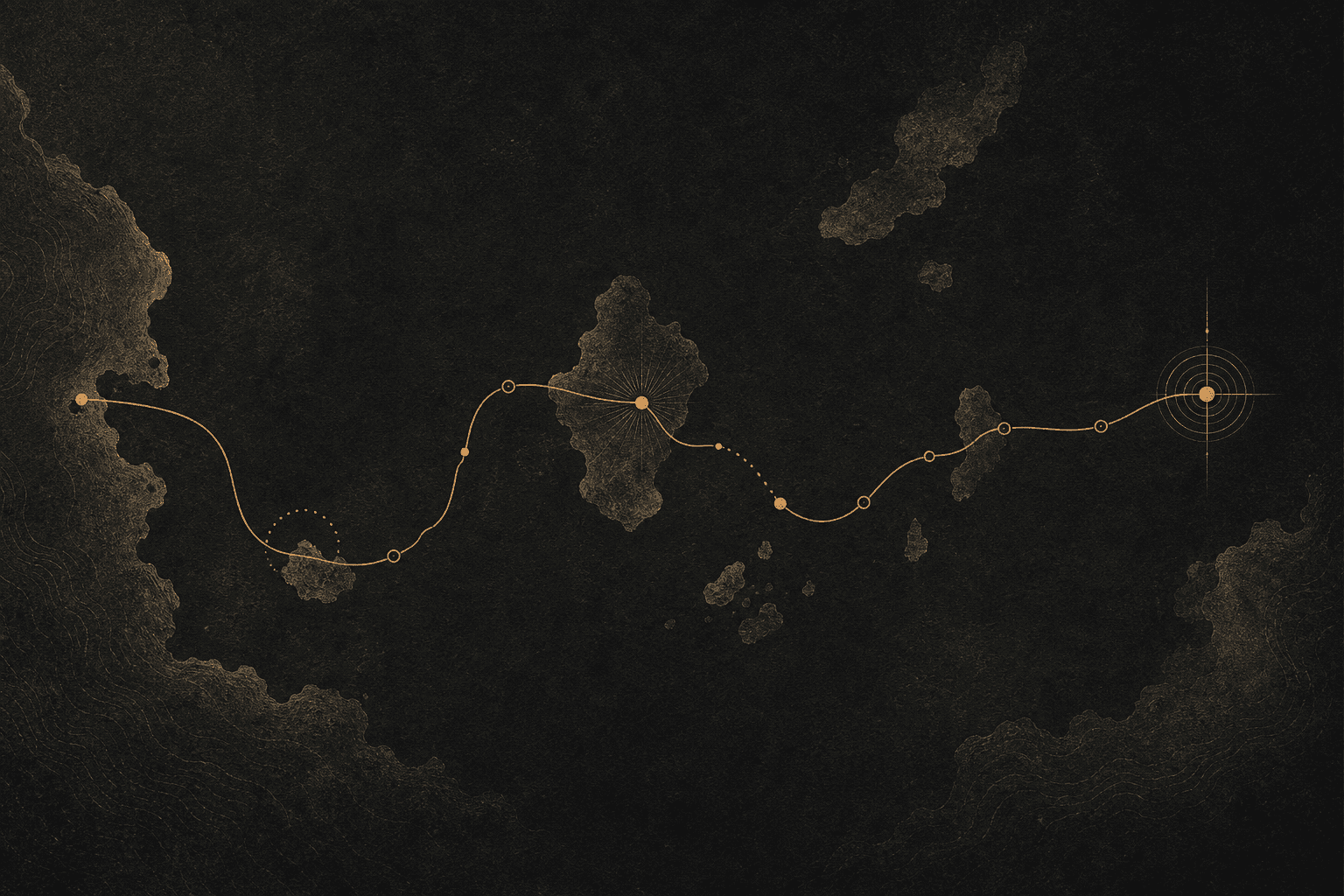
The map beneath
The Odyssey: Movie vs. the Book
The short answer
Even with the 2026 film now in theaters, the most useful comparison is one of form: a roughly two-hour film versus a poem of 24 books and about 12,000 lines. Any adaptation must compress, reorder, and cut. What only the poem gives you is Odysseus narrating his own wanderings (Books 9–12), his interior life, and the recognitions that end the story on Ithaca.
Fate, exile, temptation, return.
The outer story gets you oriented. The inner route is the reason the poem keeps finding adults again.
Updated July 21, 2026
Five things to hold onto
- The comparison is about form: a two-hour film versus Homer's 24-book, ~12,000-line poem composed around the 8th century BCE
- The poem is not linear — it opens with Telemachus (Books 1–4) and only reaches Odysseus in Book 5
- The famous wanderings (Cyclops, Circe, the dead, the Sirens) are narrated by Odysseus himself at the Phaeacian court, Books 9–12
- Only the poem gives you the narrating voice, the interior life, and the recognitions — the scar, the bow, and the bed (Books 19, 21, 23)
- Nearly half the poem happens on Ithaca (Books 13–24): the homecoming is the story, not the monsters
Complete digital edition
Read the whole poem without losing the route.
Designed PDF and EPUB, book-by-book guidance, 120+ notes, five essays, the journey map, and character cards in one download.
The 2026 film is in theaters now — but you don't need a scene-by-scene review to make the most useful comparison, because it is about form: a single film of roughly two hours versus a poem of 24 books and about 12,000 lines. That gap is the whole story of any adaptation. It tells you what a film has to do — and what only the poem can give you.
Two hours against twenty-four books
The Odyssey was composed around the 8th century BCE to be performed aloud, and it survives as 24 short "books," closer to chapters than volumes. Read at a steady pace it runs about the length of a mid-sized novel — ten to fourteen hours. A feature film has to carry the same story in a fraction of that. So the interesting question was never "will they get it right?" It is: given so little time, what must any adaptation compress, reorder, and cut?
That is a question you can answer now, without a single frame of footage, because the poem already tells you where its weight sits. For the fuller version of the story, the Odyssey explained walks the whole arc; here we are only comparing the shapes.
What any adaptation has to compress
Homer does not tell the tale in order, and that is the first thing a film tends to straighten out. The poem opens not with Odysseus but with his son: the Telemachy, Books 1–4, follows Telemachus searching for news of a father he barely remembers. Odysseus himself does not appear until Book 5, stranded on Calypso's island, weeping toward home while a goddess offers him immortality to stay.
Then comes the poem's strangest move. The famous adventures — the Cyclops (Book 9), Circe (Book 10), the land of the dead (Book 11), the Sirens and the strait of Scylla and Charybdis (Book 12) — are not shown as they happen. Odysseus narrates them himself, at a banquet at the Phaeacian court, years later, in his own voice. The journey map from Troy to Ithaca lays the route out in order, but in the text that order is a memory, not a timeline.
What only the poem gives you
Three things live almost entirely in the text.
First, the narrating voice. Half the adventure is Odysseus performing his own legend — the poem is openly about storytelling, and no camera quite reproduces a hero editing his own myth.
Second, the interior life. The poem lingers inside grief, cunning, and doubt in ways a plot cannot. Its first line, in Samuel Butler's translation, already promises a person, not a highlight reel:
Tell me, O Muse, of that ingenious hero who travelled far and wide after he had sacked the famous town of Troy.
Third, the recognitions — and this is the poem's true climax, not the monsters. Nearly half the Odyssey happens on Ithaca (Books 13–24), with Odysseus in disguise. The old nurse Eurycleia knows him by a scar (Book 19). The contest of the bow proves him (Book 21). And Penelope, no man's prize, tests him about the immovable bed built into their room before she will believe (Book 23). These quiet scenes are where the whole thing has been heading.
Read it and watch the choices being made
The honest reason to read first is not homework. It is that knowing the poem turns the film into something richer: you get to watch the choices — what is kept, folded, or cut, and what the ending is allowed to mean — instead of meeting the story cold. If you want to think this through, pair this with how faithful the film is likely to be and the honest guide to reading it.
You do not need a special edition to begin. If you would rather have the complete Odyssey and a modern companion in one place - an opening for each of the 24 books, a journey map, character cards, and a five-evening route - the Home Pack is the direct route, for $19.
Classics RediscoveredThe Odyssey Companion
We make the classics readable for modern adults. Independent and unofficial — every quotation is checkable by book number against Homer's text. Questions? hello@odysseycompanion.com
Questions people ask
Is the 2026 Odyssey movie the same as the book?
No adaptation can be. The book is a 24-book poem of roughly 12,000 lines; a feature film runs about two hours. Any version has to compress, reorder, and cut. The most likely change is the structure: Homer opens with Telemachus and turns the wanderings into a story Odysseus tells in flashback, which a film usually unfolds as live action.
What does the book have that a movie can't show?
Three things live mostly in the text: Odysseus narrating his own adventures in Books 9–12, so you doubt how much to believe; his interior life of grief and cunning; and the recognitions on Ithaca — the scar in Book 19, the bow in Book 21, and Penelope's test of the bed in Book 23. These quiet scenes, not the monsters, are the poem's real climax.
Should I read the Odyssey before seeing the film?
You don't have to — the film stands on its own. But the poem runs about the length of a mid-sized novel, and reading it first turns the film into something richer: you get to watch which episodes it keeps, folds, or cuts, and what its ending is allowed to mean, instead of meeting the story cold.
How long is the Odyssey compared to a movie?
The poem is 24 books and roughly 12,000 lines — about ten to fourteen hours of reading, or a focused week. A feature film has to tell the same story in around two hours, which is exactly why comparing the two is really a study in what an adaptation must leave out.
Keep reading
How Faithful Is the 2026 Odyssey Film to Homer?
How faithful is Nolan's 2026 Odyssey to Homer? Graded on five kinds of fidelity — plot, structure, character, ending, and emotional truth — against the poem.
Read →
Which Parts of The Odyssey Matter Most Before the Film?
The essential Odyssey books and scenes to know before the 2026 film: Telemachus, Calypso, Cyclops, Circe, underworld, Sirens, bow, and bed.
Read →
The Odyssey Explained in 15 Minutes
The whole story of Homer's Odyssey in a 15-minute read: the three-part structure, the wanderings told in flashback, the return, and the ending explained.
Read →
Can You Read The Odyssey Before July 17, 2026?
Yes: The Odyssey takes about 10-14 hours to read — before or after Christopher Nolan's movie. Honest math, a 7-day plan, and which books matter most.
Read →
Odysseus' Journey Map: Every Stop from Troy to Ithaca
Every stop on Odysseus' ten-year route from Troy to Ithaca — Cyclops, Circe, Sirens, Calypso — what happens at each one, and what it costs him.
Read →
The Odyssey 2026 Film: What to Know Before Watching
Unofficial poem-first guide to Christopher Nolan's The Odyssey (2026), now in theaters: Homer's story, the characters, and the ending the film rewrote.
Read →
Source notes
- Homer, The Odyssey, Samuel Butler translation
- Homer background: 24 books, ~12,000 lines, traditionally dated to the 8th century BCE
- Official film site: The Odyssey in theaters July 17, 2026