Penelope
Penelope and the Intelligence of Staying
The short answer
Penelope's intelligence in the Odyssey is not passive patience. She governs a house under occupation, delays the suitors with the weaving trick, protects Telemachus, controls information, and tests Odysseus with the secret of their bed. Her power is the intelligence of staying: holding the center without surrendering it.
Staying can be a form of strategy.
Penelope holds the center through delay, speech, secrecy, and the bed no impostor can know.
Updated July 7, 2026
Five things to hold onto
- Penelope holds Ithaca politically, emotionally, and symbolically.
- The weaving trick is strategy, not mere delay.
- The bow contest turns suitor violence against itself.
- The bed test proves identity through a private truth no impostor can know.
- Penelope makes homecoming possible because she keeps home from becoming only a place.
Complete digital edition
Read the whole poem without losing the route.
Designed PDF and EPUB, book-by-book guidance, 120+ notes, five essays, the journey map, and character cards in one download.
Penelope's story is easy to flatten because she does not travel. Odysseus crosses seas; Penelope remains in the house. But the poem does not treat staying as simple. In Ithaca, staying means living inside a political emergency without letting the emergency become normal.
The suitors are not only annoying guests. They consume the household, pressure the queen, threaten the son's inheritance, and turn the hall into a slow occupation. Penelope cannot sail away and cannot openly fight them. Her field of action is narrower, so her intelligence has to be finer.
For the simpler character overview, the main Penelope guide is useful; this page stays with the harder political work of remaining in the house.
The Weaving Trick
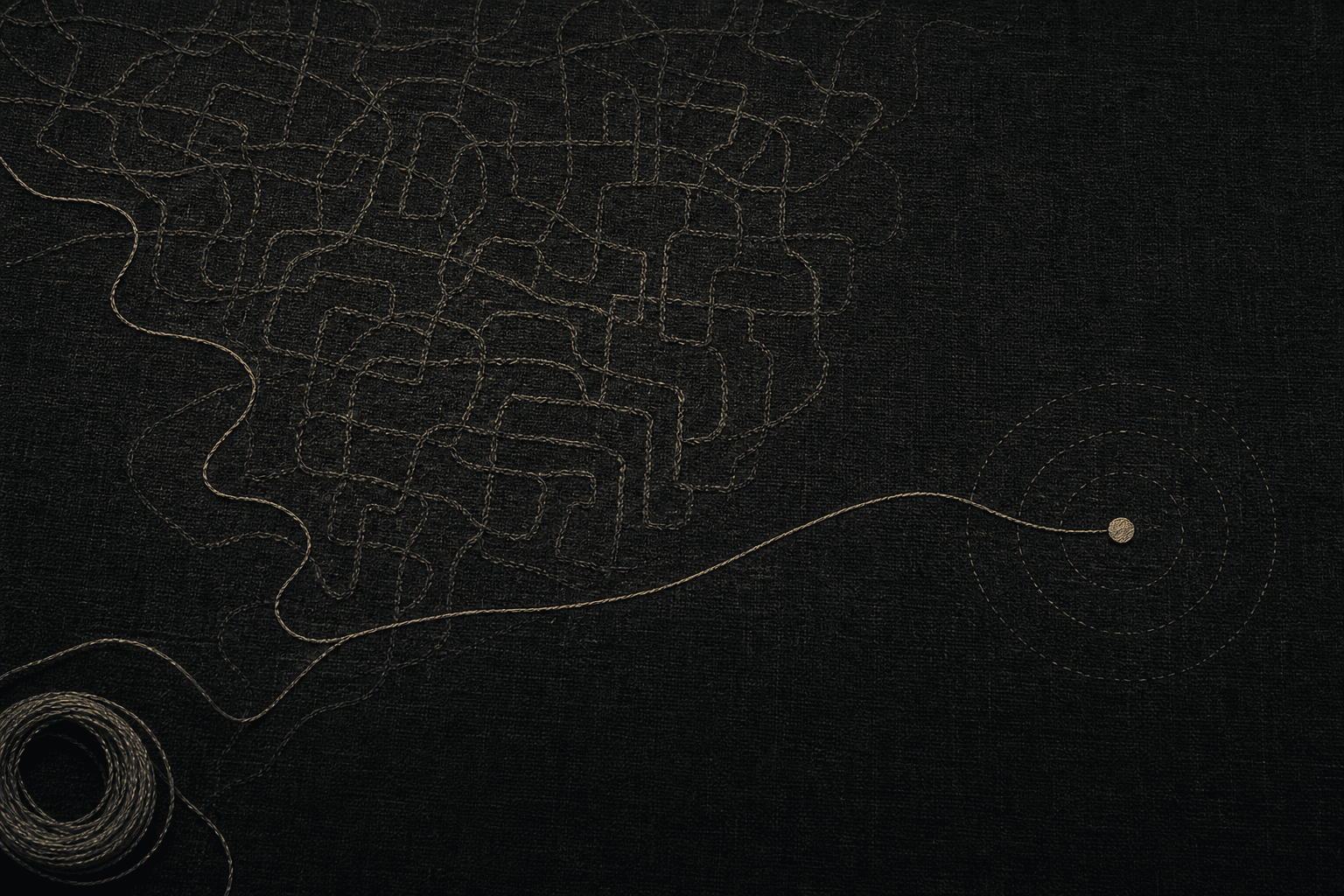
Penelope promises to choose a suitor after she finishes weaving a shroud for Laertes. By day she weaves; by night she undoes the work.
The trick is famous because it is elegant, but it is also severe. She turns time into resistance. She gives the suitors an answer that is socially legible and politically evasive. She does not defeat them; she prevents them from converting pressure into legitimacy.
That pressure also explains why Telemachus matters, since the suitors threaten not only Penelope's marriage but the son's future authority.
That is the first form of her intelligence: she keeps the future open.
The Bow
The bow contest looks like surrender. Penelope announces that she will marry whoever can string Odysseus' bow and shoot through the axes.
But the bow is not neutral. It belongs to Odysseus. It is the object through which the true king's power can return to the room. The suitors accept the test because they misunderstand the house they are trying to claim.
Penelope's move brings the hidden center of the household into public view.
It also prepares the violent turn explained in why the ending of the Odyssey is so violent: the bow is both recognition and weapon.
The Bed
After the killing, Penelope still does not collapse into recognition. She tests the stranger with the secret of the bed built around a rooted olive tree.
This is not cruelty. It is the deepest intelligence in the poem. Names can be lied about. Clothes can change. Stories can be invented. The bed cannot be improvised, because it is both object and memory: a marriage, a room, a tree, a house, a life.
That is why Ithaca after exile depends on Penelope's test; the house becomes home again only when its rooted center is known.
Odysseus proves himself by knowing what cannot be moved.
Why Staying Matters
The Odyssey is a poem about return, but return requires something to return to. Penelope is that difficult center. She keeps Ithaca from becoming only property. She keeps marriage from becoming only status. She keeps time from swallowing the absent man completely.
That is why "Penelope knew" works as more than a slogan. She knows the house, the men around her, the limits of speech, the value of delay, and the difference between appearance and recognition.
The Home Pack ($19) follows this Penelope thread through the character cards, map notes, Companion Edition annotations, and the deeper essays on recognition and return.
Classics RediscoveredThe Odyssey Companion
We make the classics readable for modern adults. Independent and unofficial — every quotation is checkable by book number against Homer's text. Questions? hello@odysseycompanion.com
Questions people ask
Is Penelope passive in the Odyssey?
No. She has limited public force, but she uses time, speech, secrecy, ritual, and testing as political tools inside an occupied household.
Why does Penelope test Odysseus?
Because a man can look like Odysseus and still need to prove he is the husband who knows the immovable bed at the center of their house.
Keep reading
Who Is Penelope? The Odyssey's Other Strategist
Penelope in the Odyssey, explained: the weaving trick, the bow contest, and the bed test — why Homer's queen of Ithaca is a strategist, not a waiting wife.
Read →
Women in The Odyssey: Power, Knowledge, and the Work of Return
Penelope, Athena, Circe, Calypso, Nausicaa, Arete, Helen, Eurycleia, and servants exercise sharply different forms of power.
Read →
Ithaca: Why Home Is Not the Same After Exile
Ithaca in the Odyssey explained: why home is not just a place, and why Odysseus' return must pass through disguise, testing, and recognition.
Read →
Who Is Who in The Odyssey?
A clear guide to the main characters in Homer's Odyssey: Odysseus, Penelope, Telemachus, Athena, Poseidon, Circe, Calypso, and more.
Read →
The Odyssey as a Story of Homecoming, Fatherhood, and Return
An unofficial guide to nostos in Homer's Odyssey: homecoming, fatherhood, and return — and the recognition scenes that restore Odysseus's name.
Read →
Why the Ending of The Odyssey Is So Violent
The violent ending of the Odyssey explained: why Odysseus kills the suitors, what happens after, and why the poem does not end neatly.
Read →
Source notes
- Homer, Odyssey, Books 1, 2, 17, 19, 21, and 23, Samuel Butler translation
- Homer, Odyssey, Book 23 (the bed test and recognition)