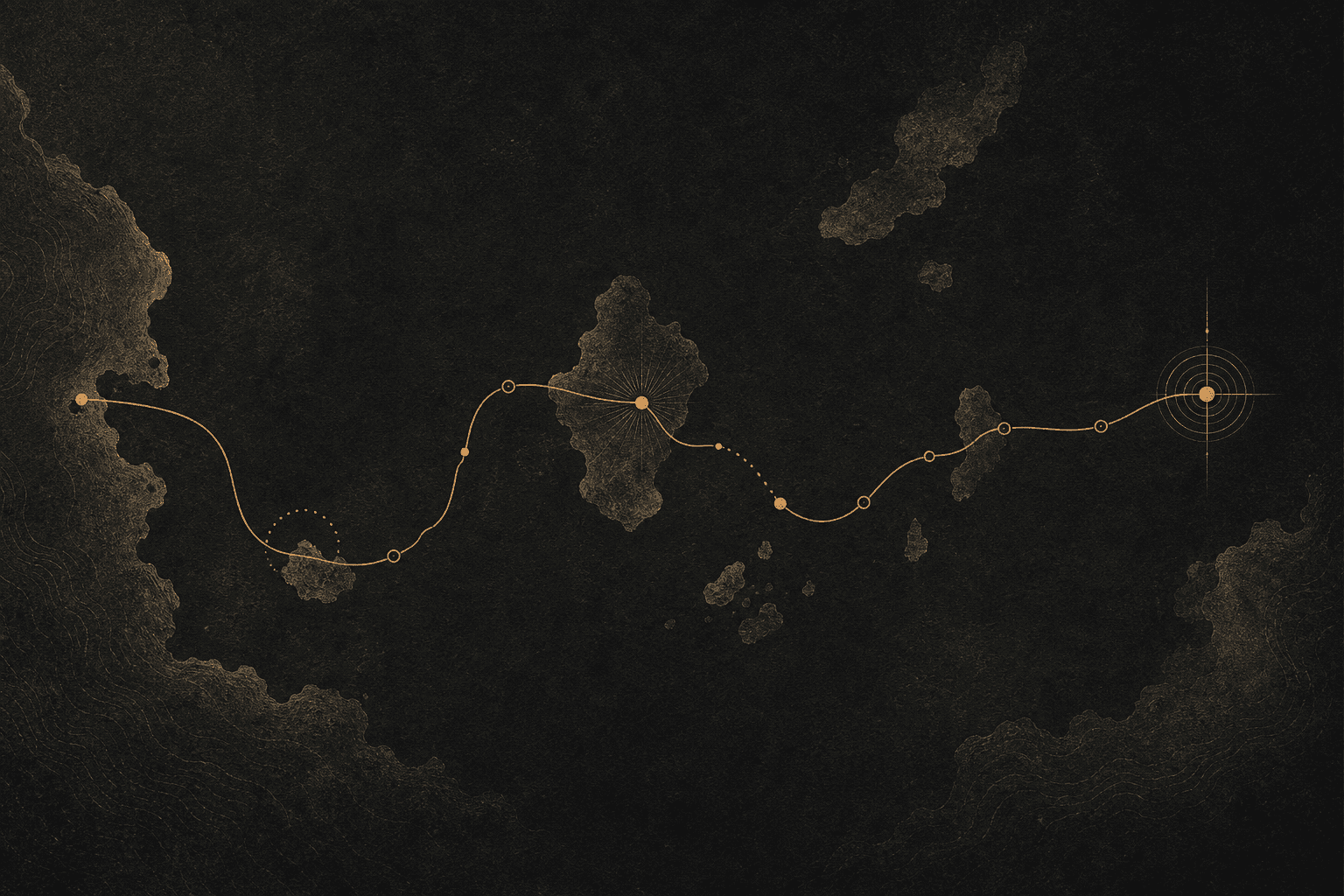
The map beneath
The Odyssey in Chronological Order (vs. Homer's Order)
The short answer
In true chronological order the Odyssey runs: the fall of Troy, the ten-year voyage home (Cyclops, Circe, the dead, the Sirens, Scylla and Charybdis), seven of those years held by Calypso, rescue at Phaeacia, and the return to Ithaca with its reckoning. Homer tells none of it in that order — he opens near the end and delivers the wanderings as a flashback in Books 9–12.
Fate, exile, temptation, return.
The outer story gets you oriented. The inner route is the reason the poem keeps finding adults again.
Updated July 7, 2026
Five things to hold onto
- Homer tells the story out of order (in medias res): the poem opens in its final year, not at Troy
- In real time the sequence is Troy, the voyage home, seven years with Calypso, Phaeacia, then Ithaca
- The famous adventures are a flashback — Odysseus narrates them himself in Books 9–12 at the Phaeacian court
- Chronologically the wanderings come first; in the book order they sit in the middle, framed by the son's search and the return
- Roughly eight of the ten years home are spent standing still — one year with Circe, seven with Calypso
Complete digital edition
Read the whole poem without losing the route.
Designed PDF and EPUB, book-by-book guidance, 120+ notes, five essays, the journey map, and character cards in one download.
If you have gone looking for the Odyssey "in chronological order," you have already noticed the thing that trips up most first-time readers: the poem refuses to tell its story in the order the events happen. That is not a defect. It is one of the oldest and most deliberate pieces of storytelling architecture in Western literature. Below are both timelines — the real sequence of events, and the order Homer actually delivers them — so you can hold one in each hand.
Why the poem is out of order
The Odyssey begins in medias res — "in the middle of things." When it opens, Odysseus of Ithaca has been gone twenty years: ten fighting at Troy, ten more lost at sea. Every ship is already wrecked, every companion already dead. His son Telemachus was an infant when he sailed and is now grown; his wife Penelope is besieged in her own house by 108 suitors. The hero himself does not appear for four books, and when he does, in Book 5, he is weeping on the shore of Calypso's island. The famous monsters are all in the past.
Homer delivers those adventures — but on his own terms, as memory rather than action.
The true chronological order
Here is the sequence as it happens in time:
- The fall of Troy. The wooden-horse stratagem, credited to Odysseus, ends the ten-year war. Homer does not narrate it directly — it is not in the Iliad either, which closes on Hector's funeral. Instead a court bard sings of the horse in Book 8, and Menelaus and Helen recall the war in Book 4.
- The wanderings — the ten-year voyage home, and the heart of what people mean by "the Odyssey": the raid on the Cicones; the Lotus-eaters; the Cyclops Polyphemus, blinded in his cave (the act that earns Poseidon's lasting grudge); Aeolus and the bag of winds; the Laestrygonian giants, who destroy eleven of twelve ships; a year with the enchantress Circe; the voyage to the land of the dead, where Tiresias maps the road home; the Sirens; the strait of Scylla and Charybdis, where Circe's counsel is to steer nearer six-headed Scylla and lose six men rather than risk the whole ship to the whirlpool; and the cattle of the Sun, whose slaughter dooms the last crew. Odysseus alone survives.
- Seven years with Calypso. He drifts to the island of the goddess Calypso, who holds him, offers him immortality, and cannot make him stop grieving for home. These seven years fall inside the ten-year return — most of the voyage is spent not moving.
- Phaeacia. Released at last, shipwrecked again by Poseidon, he washes ashore among the Phaeacians, who receive him as a nameless guest.
- The return to Ithaca. Their sailors carry him home. Disguised as a beggar, he moves through a chain of recognitions, wins the contest of his own bow, and takes the reckoning with the suitors in Book 22.
Homer's actual order
Now the same story as the poem gives it — three movements, hinged on one flashback:
- Books 1–4 — the son's search. Ithaca, the ruined household, and Telemachus travelling for news of a father he cannot remember. The hero is absent.
- Books 5–8 — the present. Odysseus freed from Calypso, wrecked, and taken in at the Phaeacian court, where a bard's song about Troy brings him to tears and the king asks: who are you?
- Books 9–12 — the flashback. His answer is the wanderings. Everything you picture as "the Odyssey" arrives here as a first-person tale, told in a single night at a stranger's table. Chronologically these events come first; in the book order they sit in the middle.
- Books 13–24 — the return. Half the poem. The disguised homecoming, the bow, the killing of the suitors, Penelope's test of the immovable marriage bed, and an imposed peace. For that sequence in full, see how the Odyssey ends.
How to actually read it
Read Homer's order, not the timeline — the non-linear shape is the achievement, and Books 9–12 read cleanly once you know they are a flashback. Keep the true chronology beside you only as a map. The Home Pack ($19) carries the complete poem in Samuel Butler's translation plus a modern companion that tracks both orders as you go. For the whole arc first, start with the Odyssey explained; to choose an edition that won't fight you, see the best Odyssey translation for first-time readers.
Classics RediscoveredThe Odyssey Companion
We make the classics readable for modern adults. Independent and unofficial — every quotation is checkable by book number against Homer's text. Questions? hello@odysseycompanion.com
Questions people ask
Why isn't the Odyssey told in chronological order?
Homer opens in medias res — in the middle of things — in the story's final year, with the fleet already lost. The most famous adventures happened years earlier, so he delivers them as a flashback: Odysseus recounts the wanderings himself, in Books 9 to 12, at a banquet on Phaeacia. The out-of-order telling is deliberate design, not a flaw.
What is the correct chronological order of the Odyssey?
The fall of Troy; the wanderings (Cicones, Lotus-eaters, Cyclops, Aeolus, Laestrygonians, Circe, the land of the dead, Sirens, Scylla and Charybdis, the cattle of the Sun); seven years held by Calypso; rescue by the Phaeacians; and the return to Ithaca — the disguise, the contest of the bow, and the reckoning with the suitors.
Should I read the Odyssey in chronological order?
No — read Homer's order. The non-linear shape is one of the poem's great achievements, and Books 9 to 12 read cleanly as a flashback once you know that is what they are. Knowing the true timeline in advance simply keeps you oriented; it is a map to read alongside the poem, not a substitute for its structure.
Keep reading
The Odyssey Explained in 15 Minutes
The whole story of Homer's Odyssey in a 15-minute read: the three-part structure, the wanderings told in flashback, the return, and the ending explained.
Read →
Odysseus' Journey Map: Every Stop from Troy to Ithaca
Every stop on Odysseus' ten-year route from Troy to Ithaca — Cyclops, Circe, Sirens, Calypso — what happens at each one, and what it costs him.
Read →
How Does The Odyssey End? The Ending Explained
How the Odyssey ends, step by step: the disguised return, the contest of the bow, the killing of the suitors, Penelope's bed test, and the final truce.
Read →
Which Parts of The Odyssey Matter Most Before the Film?
The essential Odyssey books and scenes to know before the 2026 film: Telemachus, Calypso, Cyclops, Circe, underworld, Sirens, bow, and bed.
Read →
The Odyssey as a Story of Homecoming
Why the Odyssey is really a homecoming story: nostos, Ithaca, recognition, Penelope, Telemachus, Laertes, and the cost of return.
Read →
Best Odyssey Translation for First-Time Readers
Wilson, Fagles, Fitzgerald, Lattimore, or Butler? An honest comparison of the five major Odyssey translations — and which to read for the 2026 film.
Read →
Source notes
- Homer, The Odyssey, Samuel Butler translation
- Homer background: 24 books, ~12,000 lines, traditionally dated to the 8th century BCE
- Official film site: The Odyssey in theaters July 17, 2026