The map beneath
What Is Nostos?
The short answer
Nostos is the ancient Greek word for homecoming: the return of a hero from war to his own land and household. The Odyssey is the archetypal nostos poem - its whole subject is Odysseus's return to Ithaca. The word survives inside nostalgia, which joins nostos to algos, "pain": the ache for home.
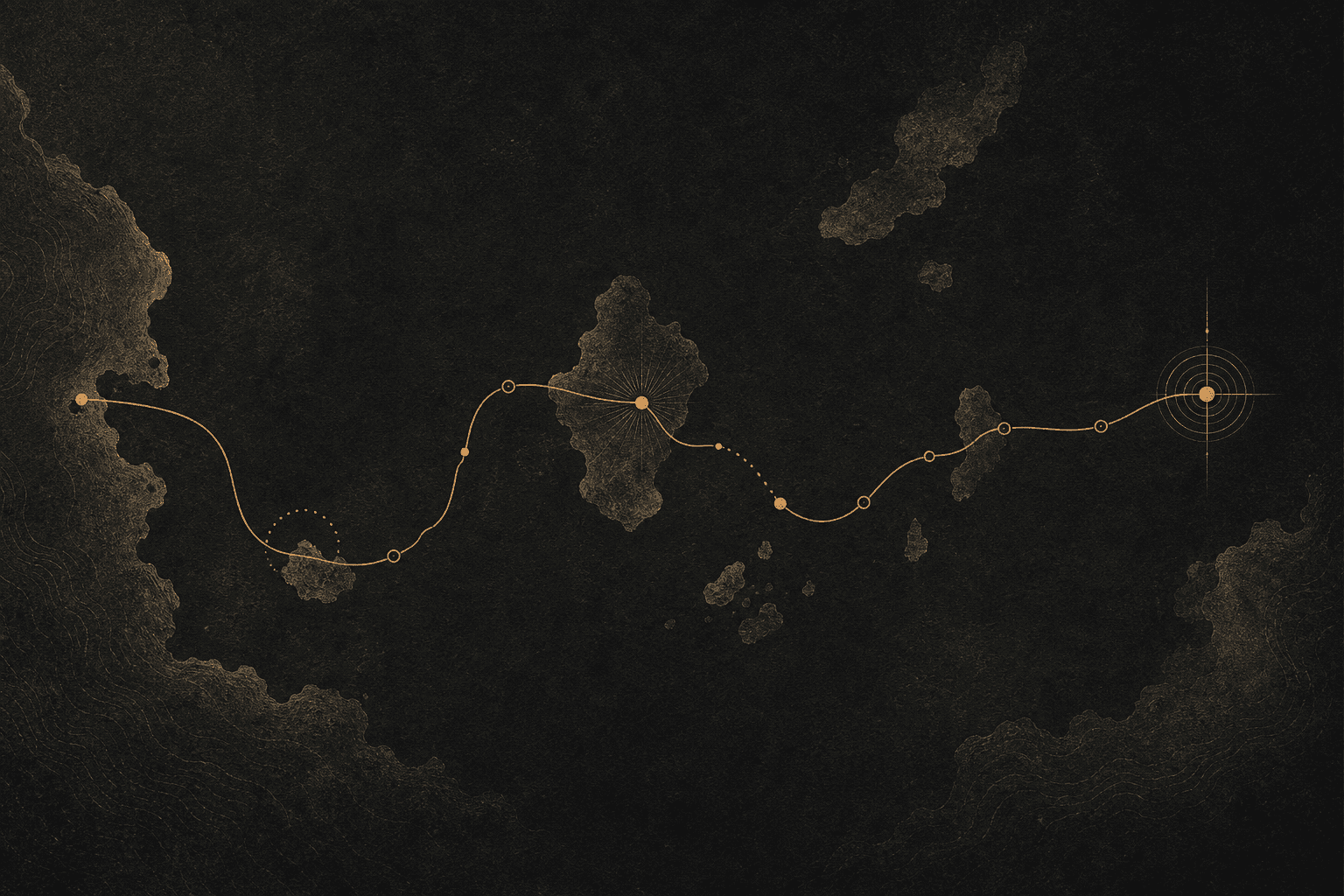
Fate, exile, temptation, return.
The outer story gets you oriented. The inner route is the reason the poem keeps finding adults again.
Updated July 7, 2026
Five things to hold onto
- Nostos means homecoming or return - the story-type the Odyssey belongs to.
- Our word nostalgia comes from nostos (return) plus algos (pain): the ache for home.
- The longing for return drives Odysseus's central choices: he refuses Calypso's immortality (Book 5) and drags his crew from the Lotus-eaters (Book 9).
- Nostos is not simple arrival - Odysseus lands on Ithaca in Book 13, yet the poem runs to Book 24.
- Homecoming in Homer is relational: a man is truly returned only when wife, son, nurse, and father know him again.
Complete digital edition
Read the whole poem without losing the route.
Designed PDF and EPUB, book-by-book guidance, 120+ notes, five essays, the journey map, and character cards in one download.
The Odyssey has a one-word subject, and the word is Greek: nostos. It means homecoming - the return of a man from war to his own land, his own house, his own name. Everything the poem is famous for, the Cyclops and the witch and the Sirens, hangs from that single idea. Odysseus is not adventuring. He is trying to get home.
The word itself
Nostos is the ancient Greek noun for a safe return, especially the return of a warrior from Troy. It named a whole class of stories the Greeks told about the homecomings of their heroes, and the Odyssey is the one that survived whole. If you want the plot in a sentence, it is a nostos: a return delayed, endured, and finally won.
The poem never lets that return be simple. Odysseus reaches Ithaca in Book 13 - and roughly a third of the epic still remains, carrying through to Book 24. He comes ashore asleep, so long gone he does not recognize his own island. Then the real work begins: entering his house disguised as a beggar, testing his servants, revealing himself to his son, winning the contest of the bow, being known again by his wife. Arrival is geography. Homecoming is something harder. For the full shape of that argument, the Odyssey as a story of homecoming follows the return from the shoreline to the marriage bed.
Nostos and nostalgia
The word did not stay in antiquity. It lives inside a term you use without thinking: nostalgia - nostos joined to algos, the Greek for pain. Literally, the pain of longing for home. The compound is far younger than Homer, but it names precisely what the Odyssey invented a form for. Nostalgia is a nostos you cannot complete.
How longing for return drives every choice
Nostos is not a backdrop in the Odyssey. It is the engine. Watch what Odysseus refuses.
When the poem finally shows us its hero, in Book 5, he is not fighting. He sits on the shore of Calypso's island, weeping toward the sea. The goddess has offered him everything a Greek hero is told to want - her bed, her island, and immortality itself, agelessness without end. He turns it down. He admits Penelope cannot rival a goddess in beauty, and chooses her anyway, along with the rocky island and the mortal, losable life that comes with it. Endless life on Ogygia is not a reward in this poem; it is exile with excellent weather. What he wants is not more life but his life. That refusal is nostos in its purest form. (See Circe, Calypso, and the Sirens for how each temptation is a variation on the same offer.)
The pattern appears again in Book 9. Odysseus's men taste the fruit of the Lotus-eaters and lose all wish to return - not through violence but through sweetness, a contentment that quietly erases the goal. He has to haul them back to the ships weeping and bind them under the benches. The danger is not a monster. It is forgetting where home was.
Nostos is relational
Homer's last insight into the word is the deepest: return is not something you do alone. In the Odyssey, identity is held in trust by other people, and homecoming happens one recognition at a time - the son, the old dog on the dung heap, the nurse who finds the scar, Penelope at the secret of their bed, the father naming the trees in his orchard. Odysseus is not truly returned when the boat touches the beach. He is returned when the last person holding a piece of his past confirms it. Homecoming, fatherhood, and return traces that ladder of recognitions rung by rung, and the poem's themes show how nostos gathers all the others under it.
Classics RediscoveredThe Odyssey Companion
We make the classics readable for modern adults. Independent and unofficial — every quotation is checkable by book number against Homer's text. Questions? hello@odysseycompanion.com
Questions people ask
What does nostos mean?
Nostos is the ancient Greek word for homecoming or return - specifically the safe return of a hero from war to his homeland. It is the story-pattern the Odyssey is built on, and it survives in the English word nostalgia.
How is nostos related to nostalgia?
Nostalgia joins nostos (homecoming) to algos (pain): literally the pain of longing for home. The compound was coined long after Homer, but it names exactly the feeling the Odyssey dramatizes - a man kept from his return, aching for it.
Why is the Odyssey called a nostos poem?
Because its entire subject is Odysseus's return to Ithaca after the Trojan War. He reaches the island in Book 13, but the poem spends its remaining books proving that arrival is not the same as homecoming.
How does nostos drive the plot?
The desire to return governs Odysseus's choices. He turns down Calypso's offer of immortality in Book 5 and forces his men away from the forgetfulness of the Lotus-eaters in Book 9 - each time choosing the mortal, losable life at home over an easier one elsewhere.
Keep reading
The Odyssey as a Story of Homecoming
Why the Odyssey is really a homecoming story: nostos, Ithaca, recognition, Penelope, Telemachus, Laertes, and the cost of return.
Read →
Kleos vs. Nostos: Glory and Homecoming in The Odyssey
What kleos and nostos mean, how glory can endanger Odysseus' return, and why his successful homecoming becomes a new kind of lasting fame.
Read →
The Odyssey as a Story of Homecoming, Fatherhood, and Return
An unofficial guide to nostos in Homer's Odyssey: homecoming, fatherhood, and return — and the recognition scenes that restore Odysseus's name.
Read →
The Odyssey Themes Explained
The major themes of the Odyssey explained for adult readers: homecoming, identity, temptation, hospitality, fate, and recognition.
Read →
Circe, Calypso, and the Sirens Explained
Circe, Calypso, and the Sirens in the Odyssey, explained: three temptations, what each one offered instead of home, and why Odysseus refused them all.
Read →
The Odyssey Explained in 15 Minutes
The whole story of Homer's Odyssey in a 15-minute read: the three-part structure, the wanderings told in flashback, the return, and the ending explained.
Read →
Who Is Penelope? The Odyssey's Other Strategist
Penelope in the Odyssey, explained: the weaving trick, the bow contest, and the bed test — why Homer's queen of Ithaca is a strategist, not a waiting wife.
Read →
Source notes
- Homer, The Odyssey, Samuel Butler translation
- Homer background: 24 books, ~12,000 lines, traditionally dated to the 8th century BCE
- Official film site: The Odyssey in theaters July 17, 2026