The route beneath
The Odyssey Book 15 Summary: Telemachus Returns to Ithaca
The short answer
In Odyssey Book 15, Athena tells Telemachus to leave Sparta and warns him about the suitors' ambush. Menelaus and Helen send him with gifts, while an eagle omen is interpreted as a sign of Odysseus's return. The fugitive seer Theoclymenus joins the ship. Telemachus avoids the ambush, lands separately, and sends the crew to town while he goes to Eumaeus's hut.
One more turn on the long way home.
Each book and episode changes the route, but the pressure is always the same: how to keep Ithaca from becoming only a memory.
Updated July 13, 2026
Five things to hold onto
- Athena directs Telemachus home and explains how to avoid the ambush.
- Helen interprets an eagle carrying a goose as a sign against the suitors.
- Theoclymenus seeks protection after killing a member of his own kin.
- Eumaeus recounts his childhood abduction and sale into Odysseus's household.
- Telemachus lands near Eumaeus rather than entering the palace directly.
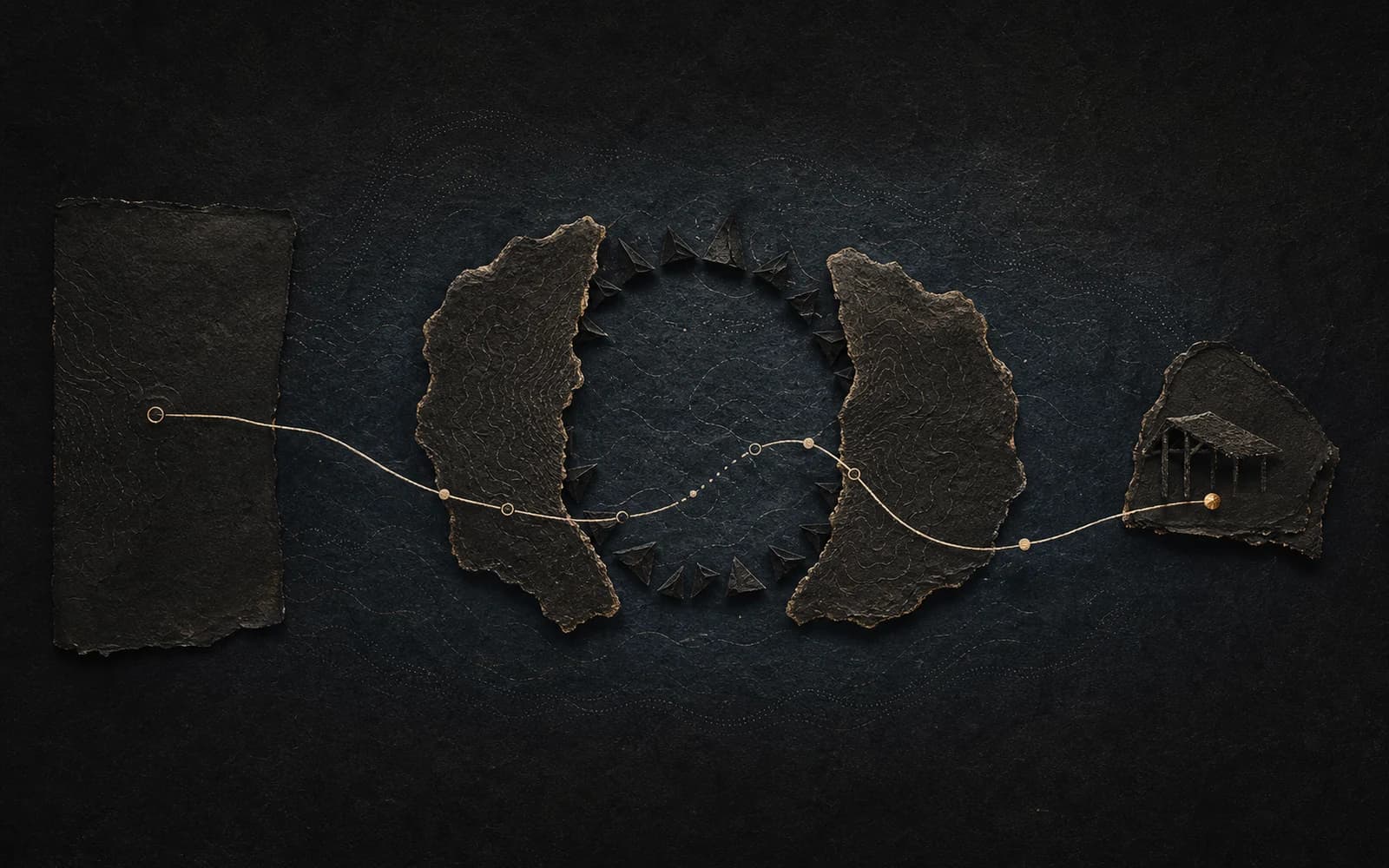
Book 15 brings Telemachus back into the main line of return. While Odysseus remains disguised at Eumaeus's hut, Athena goes to Sparta and tells the son to leave. The routes prepared since Book 1 now converge on one remote part of Ithaca.
The book alternates between Telemachus's journey and Odysseus's conversation with Eumaeus. One young man returns to the household where he was born; the older swineherd explains how he was taken from his.
Athena sends Telemachus home
Athena finds Telemachus and Peisistratus at Menelaus's palace. She warns that Penelope's father and brothers are urging her to marry Eurymachus and that household goods may follow a new marriage. More immediately, the suitors are waiting in ambush between Ithaca and Same.
Telemachus must sail by night, avoid the islands, and land at the far side of Ithaca. He should go first to Eumaeus, who will bring news to Penelope.
At dawn Telemachus wakes Peisistratus and asks to leave. The Pylian companion advises proper farewell rather than an abrupt departure, preserving the obligations of hospitality even under urgency.
Gifts and Helen's omen
Menelaus does not delay Telemachus once the young man states his need, though he offers a final meal and gifts. He gives a mixing bowl made by Hephaestus and received through earlier hospitality; Helen gives a garment she made for Telemachus's future bride.
As they depart, an eagle flies on the right carrying a domestic goose taken from the yard. Helen interprets the sign: just as the eagle came from the mountains and seized a bird raised in the house, Odysseus will return and punish the suitors—or may already be home.
The omen connects the absent predator with a household preyed upon from within. Telemachus accepts the favorable reading and travels back toward Pylos.
Telemachus leaves Peisistratus and meets Theoclymenus
Near Pylos, Telemachus asks Peisistratus to take him directly to the ship rather than back to Nestor's palace, where the old king's hospitality might delay departure. The choice is not contempt for Nestor; it is an attempt to balance social duty with mortal danger at home.
At the shore, Theoclymenus approaches. He is a seer from the family of Melampus and says he is fleeing after killing a member of his kin. He asks Telemachus for passage before pursuers find him.
Telemachus accepts the suppliant and brings him aboard. The decision mirrors the hospitality Telemachus has received: a traveler now has enough authority to protect another fugitive.
The choice also carries risk. Telemachus knows little about the man beyond his lineage, claimed offense, and immediate need. He responds to Theoclymenus as a suppliant and extends the hospitality he has recently received from others. Theoclymenus's later prophetic insight will repay the narrative attention, but Telemachus cannot know that in advance.
For his development from the uncertain speaker of Book 1, why Telemachus matters follows the change across the poem.
At the hut, Odysseus considers the palace
The narrative returns to Eumaeus. Odysseus proposes going into town to beg among the suitors and perhaps serve them. The suggestion tests what Eumaeus thinks the palace has become.
Eumaeus urges him not to go. The suitors' servants are young, well dressed, and favored; an old stranger would face abuse. He suggests waiting until Telemachus returns, because the young master will provide clothing and safe direction.
Odysseus then asks about his parents. Eumaeus reports that Anticleia is dead and Laertes remains alive but crushed by grief. He describes how Anticleia once treated him kindly alongside her daughter Ctimene.
Eumaeus tells his true history
At Odysseus's request, Eumaeus explains that he was born on the island Syrie, where his father Ctesius ruled. A Phoenician woman enslaved in the household had herself been abducted from Sidon. A visiting Phoenician trader persuaded her to escape and secretly take the child Eumaeus with her.
After sailing for several days, Artemis killed the woman. The traders continued to Ithaca and sold Eumaeus to Laertes. Anticleia raised him in the household until Ctimene married and left.
The story is one of abduction and enslavement within the same maritime world that enables trade and travel. Eumaeus's loyalty did not arise because the household was his birthplace. It developed through years of care and belonging after a violent separation.
His truthful biography also contrasts with Odysseus's invented Cretan story in Book 14. Both are tales of ships, displacement, and slavery; only one belongs to the speaker's actual life.
The ship reaches Ithaca
Telemachus's vessel sails through the night. Near Ithaca, a bird omen appears: a hawk carries a dove. Theoclymenus interprets it as evidence that Telemachus's family will retain power on the island.
Telemachus orders the crew to put him ashore before taking the ship to the town. He entrusts Theoclymenus to a loyal companion rather than bringing the fugitive directly to the dangerous palace.
The suitors' ambush fails because the return does not follow the public route they expect. Telemachus walks inland toward Eumaeus's hut, where Odysseus is waiting without his knowledge.
The return reverses his departure. Athena secretly supplied a ship in Book 2; now she supplies a concealed landing. Telemachus left to obtain knowledge about his father and comes back carrying a seer, gifts, experience of other households, and the ability to issue separate orders to his crew.
Why Book 15 matters
Return in this book depends on receiving and extending hospitality. Telemachus leaves Sparta with gifts, accepts Theoclymenus, and heads toward a servant who once arrived on Ithaca as an abducted child. Home is not defined only by birth; it is also built through protection and remembered care.
The plot is now positioned for recognition. Continue with the Book 16 summary, where Athena removes the disguise for Telemachus. The book-by-book summary shows how this private landing reverses the public departure of Book 2.
Classics RediscoveredThe Odyssey Companion
We make the classics readable for modern adults. Independent and unofficial — every quotation is checkable by book number against Homer's text. Questions? hello@odysseycompanion.com
Free reading preview
Take the route, names, and recognition scenes with you.
Get the one-evening guide and a designed preview from the complete edition. Useful on its own; clear about where to go next.
Questions people ask
How does Telemachus avoid the suitors' ambush?
Following Athena's instructions, he sails at night away from the islands where the suitors are watching, lands at a remote point on Ithaca, and sends the ship onward while he approaches Eumaeus privately.
Who is Theoclymenus?
Theoclymenus is a seer descended from Melampus. Fleeing after a killing within his kin group, he asks Telemachus for passage and later interprets signs concerning Odysseus and the suitors.
Keep reading
The Odyssey Book-by-Book Summary
A clear 24-book summary of Homer's Odyssey: Telemachus, Odysseus' wanderings, the return to Ithaca, and the ending.
Read →
The Odyssey Book 14 Summary: Eumaeus and the Beggar's Tale
Book 14 explained: Eumaeus welcomes the disguised Odysseus, condemns the suitors, and hears an elaborate false story about Crete.
Read →
Why Telemachus Matters More Than You Think
Telemachus in the Odyssey, explained: why Homer begins with Odysseus' son, and how the absent father shapes the whole poem.
Read →
The Odyssey Book 16 Summary: Odysseus and Telemachus Reunite
Book 16 explained: Athena reveals Odysseus to Telemachus, father and son plan against the suitors, and the failed ambush returns.
Read →
Source notes
- Homer, Odyssey, Book 15, Samuel Butler translation
- Homer, Odyssey, Book 15, A. T. Murray translation, Perseus Digital Library
- Homer, Odyssey, Books 4 and 16, for the ambush and father-son reunion