Intelligence and time
Penelope's Dream of the Geese in The Odyssey, Explained
The short answer
In Book 19, Penelope tells the disguised Odysseus that she dreamed of twenty geese feeding in her house. An eagle descended, broke their necks, and killed them. As she mourned, the eagle returned in human speech and said the geese were the suitors and the eagle was Odysseus, coming to destroy them. Odysseus accepts that meaning, but Penelope remains cautious because dreams can pass through deceptive ivory or truthful horn.
What holds can be as powerful as what travels.
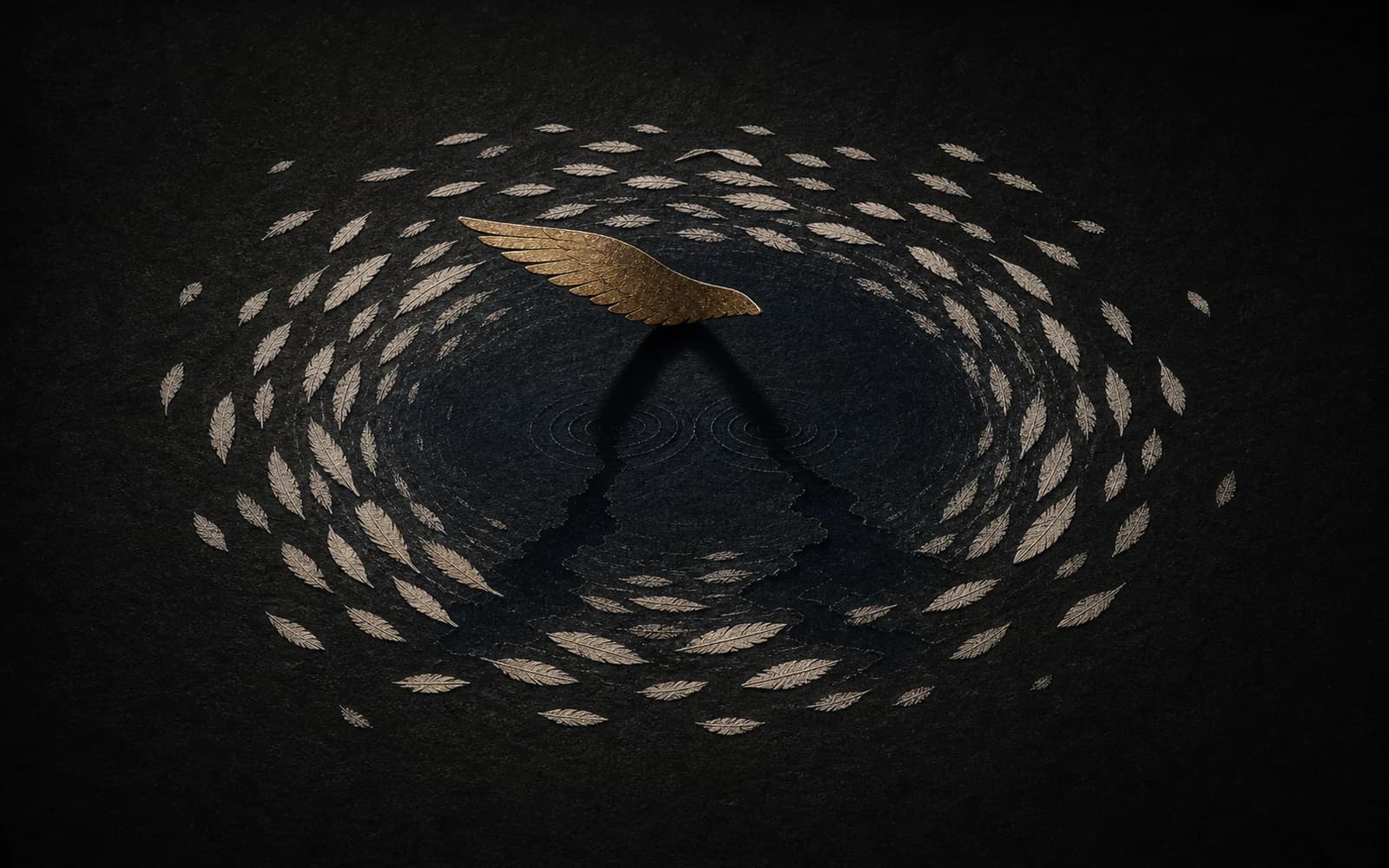
Thread, delay, memory, and careful speech form a second route through the poem: the work of keeping a world intact.
Updated July 13, 2026
Five things to hold onto
- Twenty household geese represent the suitors within the dream's own explanation.
- The eagle identifies itself as Odysseus returning to kill them.
- Penelope grieves for the geese despite their symbolic relation to the suitors.
- Odysseus says the dream has already interpreted itself.
- Penelope invokes the gates of ivory and horn to preserve uncertainty.
Penelope's dream seems unusually easy to decode because a figure inside it explains every part. The eagle is Odysseus; the geese are the suitors; the killing predicts his return. Yet Penelope does not treat even a self-interpreting dream as certainty.
That hesitation is the center of the scene. A person who has survived through doubt cannot abandon doubt because an image tells her what she wants to hear.
The dream Penelope tells
Penelope describes twenty geese that eat grain or wheat in her household and give her pleasure. An eagle descends from the mountain, kills them by breaking their necks, and flies away.
Within the dream, Penelope cries over their deaths while women gather around her. The eagle then returns, takes a place on the roof, and speaks with a human voice. It tells her not to fear: the dream is not empty but will be fulfilled.
The Book 19 summary places this account near the end of her conversation with the disguised Odysseus.
The dream interprets itself
The speaking eagle says the geese are the suitors and identifies itself as Odysseus. It promises destruction for the men occupying the house.
When Penelope asks the stranger what he thinks, Odysseus says there is no alternative interpretation. The dream has already stated its meaning.
The scene creates dramatic irony. Penelope asks Odysseus to interpret a dream in which Odysseus says he is coming, while the real Odysseus sits before her under another identity.
Why does Penelope mourn the geese?
If the geese represent predatory suitors, her grief appears strange. Several readings are possible. The dream may register the emotional complexity of a household structured around these men for years, even when their behavior is abusive. It may express horror at sudden death rather than affection for particular victims. It may also reveal that dream feeling does not obey the interpretation assigned afterward.
Penelope's position is politically trapped. The suitors threaten her house but also form the social field within which she must act. Their removal promises freedom and bloodshed at once.
This complexity belongs beside Penelope's intelligence of staying, which does not reduce her to passive waiting.
The gates of ivory and horn
Penelope responds with a general statement about dreams. Some pass through a gate of ivory and deceive; others pass through polished horn and come true. The image is connected to wordplay in Greek, though English translations handle it differently.
By invoking two gates, she refuses to decide which kind of dream she has received. Even explicit symbolism does not overcome the record of twenty uncertain years.
Her caution also prepares for the bed test. Penelope does not accept a desired conclusion until evidence belongs to shared waking reality.
Dream, omen, and action
The dream does not kill the suitors. It predicts an outcome that still requires planning, allies, locked doors, the bow, and violence. The poem's signs coexist with human action.
That relationship is central to fate and free will in The Odyssey. A prediction can be accurate without making every choice meaningless.
The dream also belongs to a larger system of omens in The Odyssey: eagles, thunder, sneezes, prophecies, and interpreted signs gain force through the people who hear and act around them.
What the dream reveals about Penelope
Penelope is able to hold interpretation and doubt simultaneously. She tells the dream to a stranger, hears the most confident reading possible, and still moves toward the bow contest rather than simply celebrating Odysseus' return.
Her response is not failure to understand symbolism. It is a refusal to let symbolism replace verification. Dreams may disclose truth, but they do not remove the need to decide how to act in a dangerous house.
The scene therefore anticipates the final reunion. Penelope's intelligence lies less in solving a riddle than in knowing that even a solved riddle may not yet be safe to trust.
Why the number twenty matters carefully
The dream contains twenty geese, but Homer does not tell readers to construct a one-to-one list pairing each bird with a named suitor. The poem elsewhere imagines a much larger group of suitors. The eagle's speech establishes the collective identity, while the number may make the household flock vivid rather than provide a census.
That distinction prevents symbolic arithmetic from becoming false plot data. A dream can condense many people into an image without preserving their literal count. Its truth concerns outcome and relation: creatures feeding inside Penelope's household are destroyed by the returning eagle.
The geese are also domesticated animals Penelope says she enjoys watching. Their transformation into suitors creates emotional dissonance. Predatory guests appear as dependent household creatures; the returning husband appears as a wild bird of prey. Moral categories and dream feeling do not align neatly.
Penelope's gate speech protects her from that ambiguity. Even if the dream's declared interpretation is right, she need not decide that every emotional element is simple or that the waking stranger before her is already proved. The bow contest and later bed test convert prediction into increasingly material evidence.
Readers should therefore resist using the dream to claim Penelope has secretly recognized Odysseus with certainty. The poem allows intuition, hope, grief, and doubt to coexist. Her intelligence is not omniscience; it is the disciplined management of uncertainty.
The dream's place in conversation reinforces that discipline. Penelope chooses to disclose it to the stranger and evaluate his response, making interpretation another test of speech. Odysseus answers confidently because he knows the plan behind the image, but he cannot yet offer the waking proof she will later demand. Prophecy advances recognition without completing it.
Classics RediscoveredThe Odyssey Companion
We make the classics readable for modern adults. Independent and unofficial — every quotation is checkable by book number against Homer's text. Questions? hello@odysseycompanion.com
Free reading preview
Take the route, names, and recognition scenes with you.
Get the one-evening guide and a designed preview from the complete edition. Useful on its own; clear about where to go next.
Questions people ask
What do the geese symbolize in Penelope's dream?
The eagle inside the dream explicitly says the geese are the suitors. Because the dream supplies its own interpretation, the main question is why Penelope still hesitates and grieves.
What are the gates of horn and ivory?
Penelope says deceptive dreams pass through ivory while dreams fulfilled in reality pass through horn. The wordplay differs by language, but the image allows her to withhold certainty.
Keep reading
The Odyssey Book 19 Summary: Penelope's Interview and the Scar
A clear Book 19 summary: Odysseus tests Penelope with a false story, Eurycleia recognizes his scar, and Penelope describes her dream and bow contest.
Read →
Penelope and the Intelligence of Staying
Penelope in the Odyssey explained as strategy, sovereignty, memory, and the intelligence required to hold a home under pressure.
Read →
Omens in The Odyssey: Eagles, Thunder, Dreams, and Signs
A guide to the Odyssey's eagle omens, thunder, dreams, sneeze, visions, prophecies, interpreters, and fulfilled predictions.
Read →
Fate and Free Will in The Odyssey
How prophecy and divine action coexist with choice, warnings, responsibility, and avoidable disaster in Homer's Odyssey.
Read →