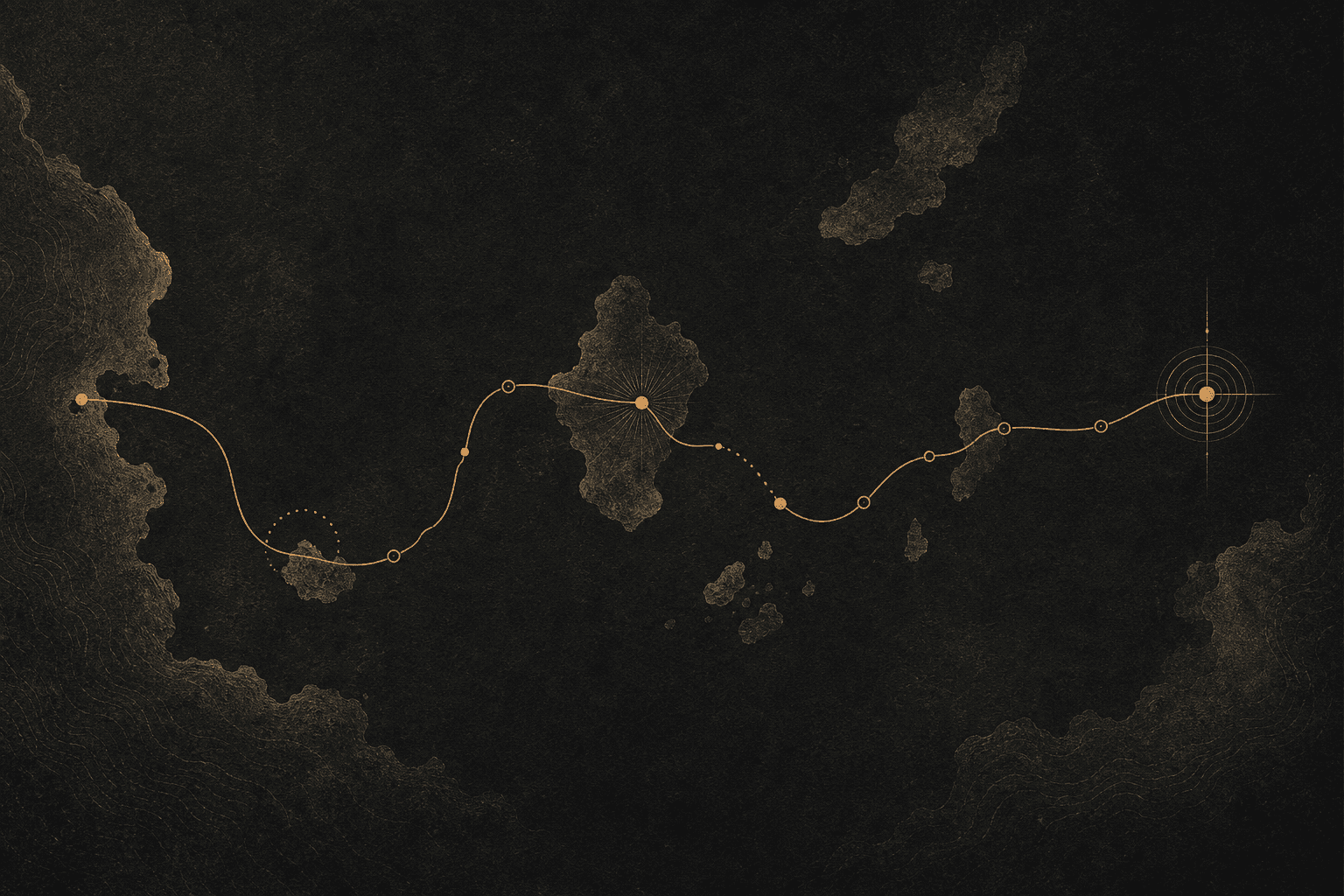
The map beneath
Penelope's Web: The Shroud Trick in the Odyssey
The short answer
Penelope's web is her three-year stalling trick against the suitors. She vows to remarry only once she finishes weaving a burial cloth for Laertes, then secretly unpicks each day's work by torchlight every night — undoing the weaving so it never ends. A maid finally betrays her. It is the female mirror of Odysseus's cunning: metis used to hold ground rather than escape.
Fate, exile, temptation, return.
The outer story gets you oriented. The inner route is the reason the poem keeps finding adults again.
Updated July 7, 2026
Five things to hold onto
- Penelope promises to remarry only after she finishes weaving a burial cloth for Laertes, then unpicks it nightly so it is never done (Books 2, 19, 24)
- The trick holds the suitors off for three full years; a disloyal maid betrays her in the fourth, and she is caught in the act of undoing the work
- Homer tells the story three times — by the suitor Antinous (Book 2), by Penelope herself (Book 19), and by a dead suitor's ghost (Book 24)
- In Samuel Butler's translation the cloth is a 'pall' for Laertes, and Penelope calls the plan inventing 'stratagems' to deceive the suitors (Book 19)
- The web is the female mirror of Odysseus's metis — cunning intelligence used to hold ground and buy time rather than to escape
Complete digital edition
Read the whole poem without losing the route.
Designed PDF and EPUB, book-by-book guidance, 120+ notes, five essays, the journey map, and character cards in one download.
Homer tells the story of the web three separate times, and never once from Penelope's point of view first. We hear it in Book 2 from Antinous, the suitor she has been cheating; in Book 24 from the ghost of another suitor, complaining about it in the land of the dead; and only in Book 19 from Penelope herself, quietly, to a beggar she does not yet know is her husband. A trick recounted by its victims twice before its author gets to speak is a trick the poem wants you to admire.
The promise and the unpicking
The setup is a piece of social engineering. Penelope cannot refuse the suitors outright — more than a hundred men occupy her hall — so she gives them a reason to wait that no one can honorably attack. She is weaving a burial cloth for Laertes, her aging father-in-law, and it would shame the house to bury a rich man without one. In Samuel Butler's translation the cloth is a pall, not the "shroud" of later versions, but the mechanism is identical. By day she works the loom in full view. By night she takes it apart.
Antinous lays out the whole scheme in Book 2, still sore about it:
"This was what she said, and we assented; whereon we could see her working on her great web all day long, but at night she would unpick the stitches again by torchlight. She fooled us in this way for three years and we never found her out." (Book 2)
Three years. A crowd of men whose entire occupation is watching this one woman fail to notice, because the work always seems to be progressing. The pall is not a delay — it is a machine for manufacturing delay, a project engineered to advance visibly and finish never.
Metis: the female mirror of Odysseus
The Greek word for Odysseus's defining gift is metis — cunning intelligence, the art of turning a losing position with a trick. He blinds a giant by calling himself Nobody. He hides an army in a wooden horse. Penelope's web is the same intelligence, worked in the opposite direction. His metis is for escaping; hers is for staying put and holding ground.
When she finally tells it herself in Book 19, she names it plainly:
"They want me to marry again at once, and I have to invent stratagems in order to deceive them." (Book 19)
Stratagems. Not endurance, not hope — deception, deliberately invented. And the suitors understand exactly what was done to them. In Book 24 the ghost of Amphimedon, murdered and bitter, admits she out-thought them from the start: "she meant to compass our destruction: this, then, was the trick she played us" (Book 24). Her weapon was time, and she made time out of thread.
Why a maid ends it
The trick fails only because it is betrayed from inside. A disloyal maid tells the suitors, and they catch Penelope in the act — "we caught her in the act of undoing her work, so she had to finish it whether she would or no" (Book 2). This detail matters. No suitor was clever enough to see through the web; it took an informer. Penelope out-strategized every man in the room, and the fourth year came only through treachery, not defeat. The web buys her the time she needs — Telemachus grows up, Odysseus finally lands, the endgame arrives — before the loom runs out.
Where the web fits the whole homecoming
The loom is the opening move of a longer game that runs through the bow contest and the test of the bed — three strategies by the same mind, each one a puzzle only the right person can solve. To see how they connect, start with who Penelope is and why Telemachus matters to the household she is protecting. The web is not a side-story to Odysseus's return; it is the reason there is a home left to return to.
For readers who want the shroud passages set beside the bow and the bed — in Butler's text, with notes on the three tellings — the Home Pack ($19) carries Penelope's whole thread through character cards, the recognition scenes, and the complete digital poem. It is the cleanest way into the Odyssey, explained as one connected design rather than a string of adventures.
Classics RediscoveredThe Odyssey Companion
We make the classics readable for modern adults. Independent and unofficial — every quotation is checkable by book number against Homer's text. Questions? hello@odysseycompanion.com
Questions people ask
What is Penelope's web or the shroud trick?
Penelope tells the suitors she will only remarry once she has finished weaving a burial cloth for her father-in-law Laertes. She weaves it by day and secretly unravels the same work each night, so it is never finished. The unfinishable weaving stalls the suitors for three years (told in Books 2, 19, and 24).
How long did Penelope's weaving trick fool the suitors?
Three full years. In Book 2 the suitor Antinous complains that she fooled them for three years without being caught, until a disloyal maid revealed the deception in the fourth year and the suitors caught her unpicking the work by night. Penelope tells the same three-year span herself in Book 19.
Is it a shroud or a pall in the Odyssey?
Both refer to the same burial cloth for Laertes. Many modern translations call it a shroud; Samuel Butler's translation calls it a 'pall.' The object and the trick are identical — a funeral cloth Penelope weaves by day and unpicks by night.
Why is Penelope's web compared to Odysseus's cunning?
Both rely on metis, cunning intelligence. Odysseus uses trickery to escape — the wooden horse, calling himself Nobody. Penelope uses the same intelligence to stay and hold her ground, turning thread into time. Homer files the web under cunning, not passive grief.
Keep reading
Who Is Penelope? The Odyssey's Other Strategist
Penelope in the Odyssey, explained: the weaving trick, the bow contest, and the bed test — why Homer's queen of Ithaca is a strategist, not a waiting wife.
Read →
Penelope and the Intelligence of Staying
Penelope in the Odyssey explained as strategy, sovereignty, memory, and the intelligence required to hold a home under pressure.
Read →
Why Telemachus Matters More Than You Think
Telemachus in the Odyssey, explained: why Homer begins with Odysseus' son, and how the absent father shapes the whole poem.
Read →
Who Are the Suitors in The Odyssey?
The suitors in the Odyssey are the young men courting Penelope and devouring Odysseus's estate. Who they are, what they represent, and how they die in Book 22.
Read →
Who Is Who in The Odyssey?
A clear guide to the main characters in Homer's Odyssey: Odysseus, Penelope, Telemachus, Athena, Poseidon, Circe, Calypso, and more.
Read →
The Odyssey Explained in 15 Minutes
The whole story of Homer's Odyssey in a 15-minute read: the three-part structure, the wanderings told in flashback, the return, and the ending explained.
Read →
Source notes
- Homer, The Odyssey, Samuel Butler translation
- Homer background: 24 books, ~12,000 lines, traditionally dated to the 8th century BCE
- Official film site: The Odyssey in theaters July 17, 2026