The intelligence of home
Anne Hathaway's Penelope vs. Homer's Penelope
The short answer
Anne Hathaway's Penelope is presented in post-release character reporting as more than a passive wife waiting at home. That is consistent with Homer. The poem makes Penelope a political and interpretive strategist who manages the suitors, controls information, tests stories, devises the bow contest, and verifies Odysseus through the secret of their immovable bed.
The house has its own strategy.
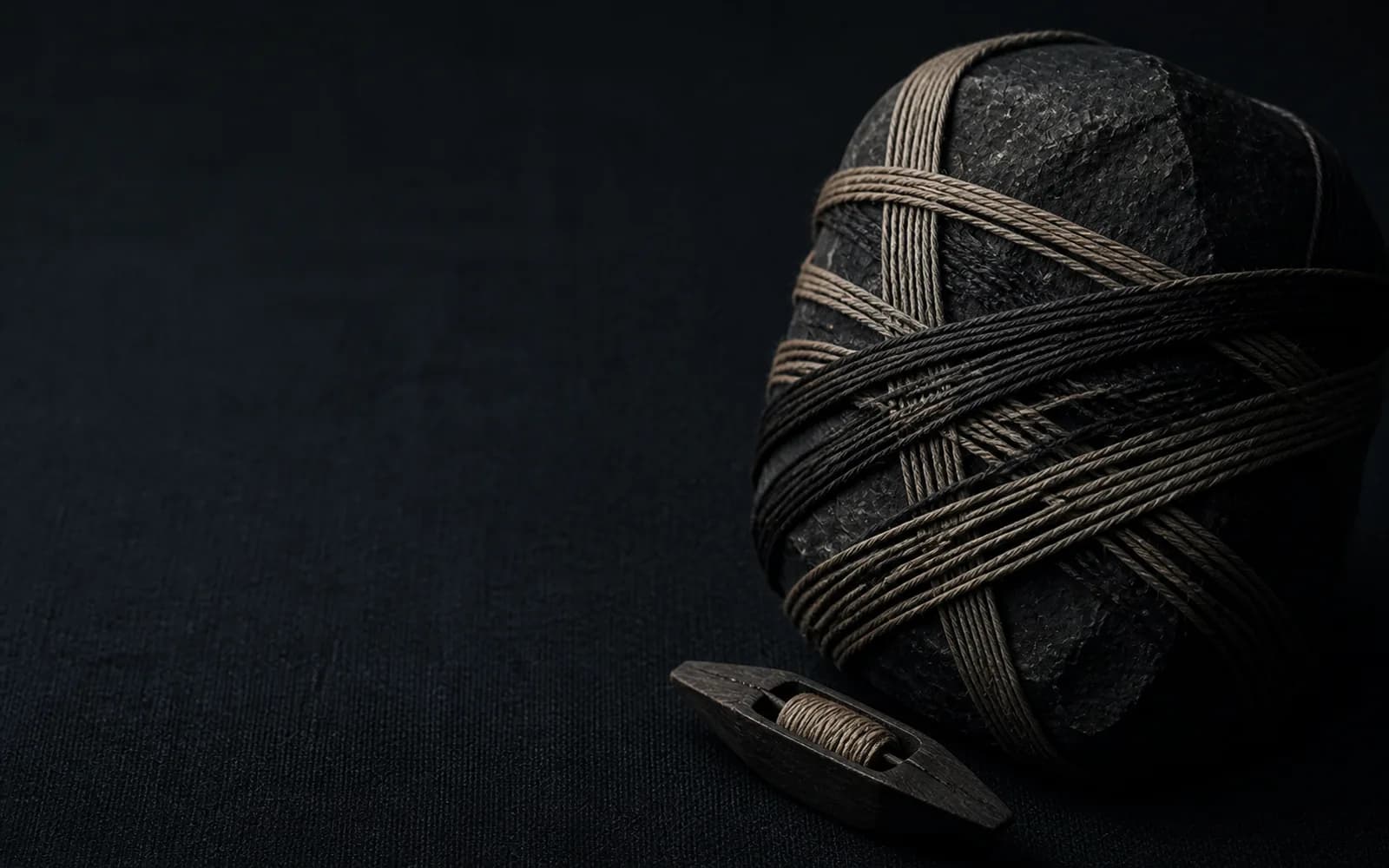
Thread, delay, secrecy, and patient attention show that staying can be as exacting and dangerous as travel.
Updated August 1, 2026
Four things to hold onto
- Penelope's waiting is active household government under sustained pressure.
- The loom trick turns time and domestic labor into political strategy.
- She does not simply fail to recognize Odysseus; she protects the standard of proof.
- The bed test gives Penelope control over the final recognition.
Anne Hathaway's Penelope is best compared with Homer by discarding one misleading picture: a motionless wife who simply waits. The Associated Press character guide presents the screen figure as a person with agency beyond patient endurance. Homer already supplies the foundation for that reading.
Penelope cannot sail after Odysseus or openly defeat the suitors by force. Her intelligence works through time, language, domestic objects, public performance, and standards of proof.
The political situation inside the house
For years, powerful men occupy Odysseus' household, consume its wealth, pressure Penelope to remarry, and diminish Telemachus. Her problem is not private indecision. The future of the kingship, property, and family line is being contested around her.
Homer gives Penelope limited formal power but considerable practical influence. She appears before the suitors, rebukes them, asks for gifts, questions strangers, and manages what can be known about her intentions.
Post-release reporting about Hathaway's role should therefore be read as characterization evidence, not as the discovery of a wholly modern Penelope. The poem's queen is already strategic. Adaptation determines which strategies become visible.
The loom is an instrument of government
Penelope tells the suitors that she will choose a husband after finishing a burial shroud for Laertes. She weaves by day and secretly unweaves at night until a servant exposes the plan.
The trick is often summarized as fidelity. It is also administration. Penelope creates a rule the suitors must publicly respect, attaches it to family duty, and uses repetitive labor to manufacture time.
The intelligence is specifically hers. No god hands her a weapon, and no returning husband designs the delay. She takes an activity associated with the private household and turns it into a defense of that household.
That is why Penelope and the intelligence of staying is a more accurate frame than "the woman who waited."
Penelope reads stories carefully
When the disguised Odysseus enters the palace, Penelope does not receive him as a blank source of comfort. She questions him about her husband and tests the credibility of his account.
Odysseus responds with one of his constructed biographies. The conversation is emotionally charged because he is both the subject of the story and the person telling it under another name.
Readers sometimes ask whether Penelope secretly recognizes him at this point. The poem encourages suspicion without resolving it explicitly. Her restraint remains meaningful either way. A ruler surrounded by manipulation cannot afford to treat desire as proof.
The bow contest belongs to her plan
Penelope brings out Odysseus' bow and announces the contest: the man who can string it and shoot through the axes will marry her. The test gathers identity, household history, physical skill, and public procedure into one object.
Athena and Odysseus drive the larger return plot, but Penelope sets the immediate terms under which the bow re-enters the hall. The suitors expose their inadequacy before Odysseus takes control of it.
The scene gives adaptation a choice. It can present Penelope as triggering an action she does not fully understand, or as a strategist forcing a crisis. Homer leaves enough tension for performance and staging to matter.
The bed test is the final authority
After the suitors are dead, Penelope still refuses instant recognition. She instructs that the marriage bed be moved. Odysseus reacts because he built it around a living olive tree; moving it would require destroying its construction.
This is not a sentimental password added after the real climax. It is the last and most private test. Athena can change Odysseus' appearance. A scar can be seen by servants. The bed belongs to knowledge shared by the couple.
Penelope therefore controls the point at which return becomes homecoming. She does not reward appearance, violence, or male testimony. She asks for knowledge that joins memory to material reality.
See the full explanation of the olive-tree bed test for the sequence in Book 23.
Where a film can differ
A film must decide how much Penelope knows and when she knows it. Close-ups, pauses, or a repeated object can imply recognition earlier than Homer's narration confirms. Compression can also place her decisions closer together, making a long strategy feel like a single plot turn.
The fair comparison is not whether Hathaway looks sufficiently patient. It is whether the character retains Penelope's forms of intelligence: delaying without surrendering, questioning without exposing herself, using household objects politically, and demanding proof no outsider can counterfeit.
Interpretation begins only after those distinctions are clear. A modern viewer may read the bed as marital intimacy, sovereignty, rooted identity, or resistance to a world made unstable by war. Homer supports all four possibilities without reducing Penelope to a symbol.
For the names, household stakes, and recognition sequence in one concise route, get the free one-evening Odyssey guide. It is a useful starting point before reading Penelope across Books 1, 17-19, 21, and 23.
Classics RediscoveredThe Odyssey Companion
We make the classics readable for modern adults. Independent and unofficial — every quotation is checkable by book number against Homer's text. Questions? hello@odysseycompanion.com
Free reading preview
Take the route, names, and recognition scenes with you.
Get the one-evening guide and a designed preview from the complete edition. Useful on its own; clear about where to go next.
Questions people ask
Is Penelope passive in Homer's Odyssey?
No. Her options are constrained, but she repeatedly shapes events through delay, public speech, guarded questioning, the bow contest, and the final bed test.
Why does Penelope weave and unweave the shroud?
She promises to choose a husband after completing Laertes' burial cloth, then secretly reverses the work at night. The plan converts domestic duty into three years of political delay.
Does Penelope know the beggar is Odysseus?
The poem sustains ambiguity, but it does not give an explicit recognition before the bed test. Her caution matters more than solving the scene as a hidden certainty.
Keep reading
Christopher Nolan's Odyssey Cast and Characters
A clear guide to The Odyssey cast, the characters they play, and the Homeric relationships worth knowing before or after the film.
Read →
Who Is Penelope? The Odyssey's Other Strategist
Penelope in the Odyssey, explained: the weaving trick, the bow contest, and the bed test — why Homer's queen of Ithaca is a strategist, not a waiting wife.
Read →
Penelope and the Intelligence of Staying
Penelope in the Odyssey explained as strategy, sovereignty, memory, and the intelligence required to hold a home under pressure.
Read →
Penelope's Bed Test in The Odyssey, Explained
How Penelope tests Odysseus with their immovable olive-tree bed, why he reacts, and how shared knowledge completes the homecoming.
Read →