Pressure
The Laestrygonians in The Odyssey, Explained
The short answer
The Laestrygonians are a giant, violent people encountered in Book 10. Eleven of Odysseus' twelve ships enter their enclosed harbor, while his own remains outside. Scouts reach the royal house, where the king attacks one of them. Laestrygonians then hurl rocks from the cliffs, spear the trapped crews, and destroy every ship in the harbor. Odysseus cuts his cable and escapes with the only surviving vessel.
The sea makes every choice harder to hide from.
Storm, hunger, command, resistance, and consequence expose what a person and a crew become when control disappears.
Updated July 13, 2026
Five things to hold onto
- The harbor's narrow entrance turns shelter into a trap.
- Odysseus alone moors his ship outside the enclosed harbor.
- Three scouts encounter the Laestrygonian royal household.
- Eleven ships and their crews are destroyed.
- The narrative changes from a fleet's return to one ship's survival.
The Laestrygonian episode destroys the scale of Odysseus' return. He arrives with twelve ships; he leaves with one. Unlike the Cyclops encounter, this disaster is not confined to a cave or caused by a single monster. An entire harbor becomes a killing mechanism.
Homer narrates the episode quickly in Book 10, between the failed return from Aeolus and the longer stay with Circe. Its brevity makes the loss feel even more abrupt.
The harbor that looks safe
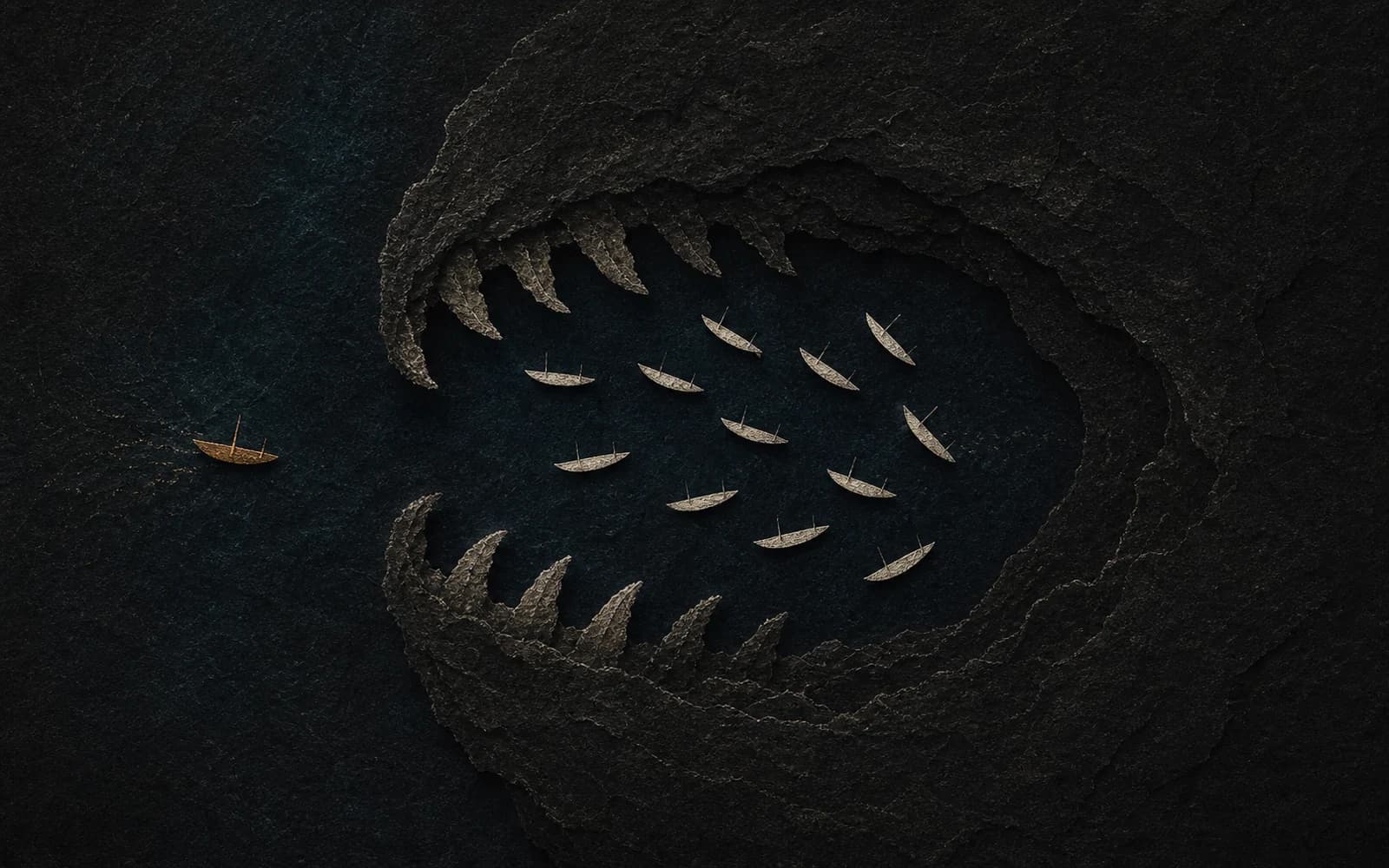
The fleet reaches a harbor surrounded by steep cliffs, with a narrow entrance and calm water inside. Eleven captains take their ships into the enclosed space and tie them close together. Odysseus keeps his vessel outside, fastening it to a rock at the edge.
The choice saves his ship, but Homer does not explain it as supernatural foresight. Odysseus is more cautious than the others, or at least less committed to the apparently protected anchorage.
On the journey map, the location marks the moment the fleet disappears as a fleet.
The scouts and the royal house
Odysseus climbs to look for signs of human activity and sees smoke. He sends three men inland. They meet a young woman drawing water, the daughter of the Laestrygonian king Antiphates, who directs them to the palace.
The domestic pattern initially resembles an ordinary encounter: water, daughter, house, ruler. It turns immediately hostile. The queen is terrifyingly large, and Antiphates seizes one scout for food. The other two flee.
The scene corrupts hospitality at the level of the royal household. A visitor reaches the king and becomes meat rather than guest.
The destruction from the cliffs
Antiphates calls the other Laestrygonians. They gather above the harbor and throw massive rocks onto the packed ships. The narrow entrance that promised shelter prevents escape. Men are speared and carried away.
Odysseus draws his sword and cuts his ship's cable rather than waiting to untie it. He orders the crew to row. Because the vessel is outside the trap, it escapes.
Eleven ships are lost. Homer does not give enough crew numbers to calculate the deaths, which is why the total number of Odysseus' lost men cannot be known exactly.
How the Laestrygonians differ from Polyphemus
Polyphemus lives outside ordinary civic order, without assemblies or shared law. The Laestrygonians have a city, roads, water source, royal household, and coordinated population. Social organization has not made them hospitable.
Their violence is also tactical. They use geography, high ground, projectiles, and the fleet's concentration against it. The Cyclops traps one group behind a stone; the Laestrygonians trap nearly an entire navy through the shape of a harbor.
Compare the moral structures in the Cyclops and Polyphemus.
Why the harbor matters
The episode turns the idea of safety inside out. The calm inner water is more dangerous than exposure outside. Every captain except Odysseus chooses protection from the open sea and becomes unable to maneuver.
That does not create a universal lesson that caution always wins. It reveals how The Odyssey repeatedly makes boundaries unstable: caves become prisons, islands become delays, palaces can host or devour, and home itself can be occupied.
Odysseus' marginal position saves him. In later Ithaca, he will again survive by remaining outside normal recognition until he understands the trap.
The leadership turning point
After the Laestrygonians, Odysseus no longer commands a distributed fleet. Every remaining risk falls on one ship, and every future mistake threatens everyone left. That makes secrecy, morale, food, and obedience even more important.
The episode belongs in an audit of leadership in The Odyssey. Odysseus' mooring decision works, but he does not extend that caution to the other captains or prevent the fleet from entering. Homer gives him survival without a clean triumph.
The ship that escapes will eventually be destroyed after the cattle of the Sun. The harbor is therefore not the final loss, but it creates the lonely scale of everything that follows.
What the episode leaves uncertain
Homer gives no exact modern location for the Laestrygonian city and no reliable crew total for the destroyed ships. Later readers have proposed geographic identifications, but the narrative does not require one fixed harbor on a contemporary map. Its crucial features are internal: enclosed water, high cliffs, a narrow mouth, and attackers able to dominate it from above.
The poem also does not say that all giants are one people or that the Laestrygonians belong to Polyphemus' family. Similar size and cannibalistic violence create comparison, not genealogy. Polyphemus is a named Cyclops and son of Poseidon; Antiphates rules a distinct, organized community.
Nor can we calculate a death toll by assigning a standard number to every ship. Earlier losses at Ismarus were distributed six per vessel, but Homer's fleet may not have begun with equal complements, and no count is given at the harbor. The responsible language is “eleven ships and their crews,” followed by explicit uncertainty.
These limits matter because the episode's meaning does not depend on invented precision. The reader feels the fleet become one ship, and every later decision occurs under that irreversible narrowing. The absence of numbers makes the surviving vessel's isolation clearer, not less significant.
The scouts' route from water source to royal house also deserves notice. Elsewhere in the poem, a daughter near water can guide a stranger toward generous rulers, as Nausicaa later does. Here the same social path leads to consumption. Homer repeats recognizable forms—girl, palace, king, meal—while reversing their moral result, teaching travelers that appearance alone cannot identify a hospitable society.
Classics RediscoveredThe Odyssey Companion
We make the classics readable for modern adults. Independent and unofficial — every quotation is checkable by book number against Homer's text. Questions? hello@odysseycompanion.com
Free reading preview
Take the route, names, and recognition scenes with you.
Get the one-evening guide and a designed preview from the complete edition. Useful on its own; clear about where to go next.
Questions people ask
How many ships do the Laestrygonians destroy?
They destroy eleven of Odysseus' twelve ships. His own ship escapes because it was moored outside the enclosed harbor rather than inside with the fleet.
Are the Laestrygonians cannibals?
Homer presents them as giant attackers who spear the trapped men like fish and carry them away as food. Their violence echoes the Cyclops while operating as a coordinated society.
Keep reading
How Many Men Did Odysseus Lose in The Odyssey?
Why Homer does not permit one exact crew total, plus the losses we can count: twelve ships, six per ship at Ismarus, and later disasters.
Read →
Odysseus' Journey Map: Every Stop from Troy to Ithaca
Every stop on Odysseus' ten-year route from Troy to Ithaca — Cyclops, Circe, Sirens, Calypso — what happens at each one, and what it costs him.
Read →
The Cyclops: Polyphemus and Odysseus
The story of the Cyclops in the Odyssey (Book 9): the cave, the wine, the "Nobody" trick, the blinding, the escape beneath the rams, and the fatal boast.
Read →
Leadership in The Odyssey: Why Odysseus Loses Every Ship
An episode-by-episode audit of Odysseus's leadership: command failures, crew disobedience, divine hostility, bad luck, and survival.
Read →
The Odyssey Book 10 Summary: Aeolus, Laestrygonians, and Circe
Book 10 explained: the bag of winds, Laestrygonian destruction, Circe's enchantment, Hermes's aid, and the command to visit the dead.
Read →