The route beneath
The Odyssey Book 21 Summary: The Bow Contest
The short answer
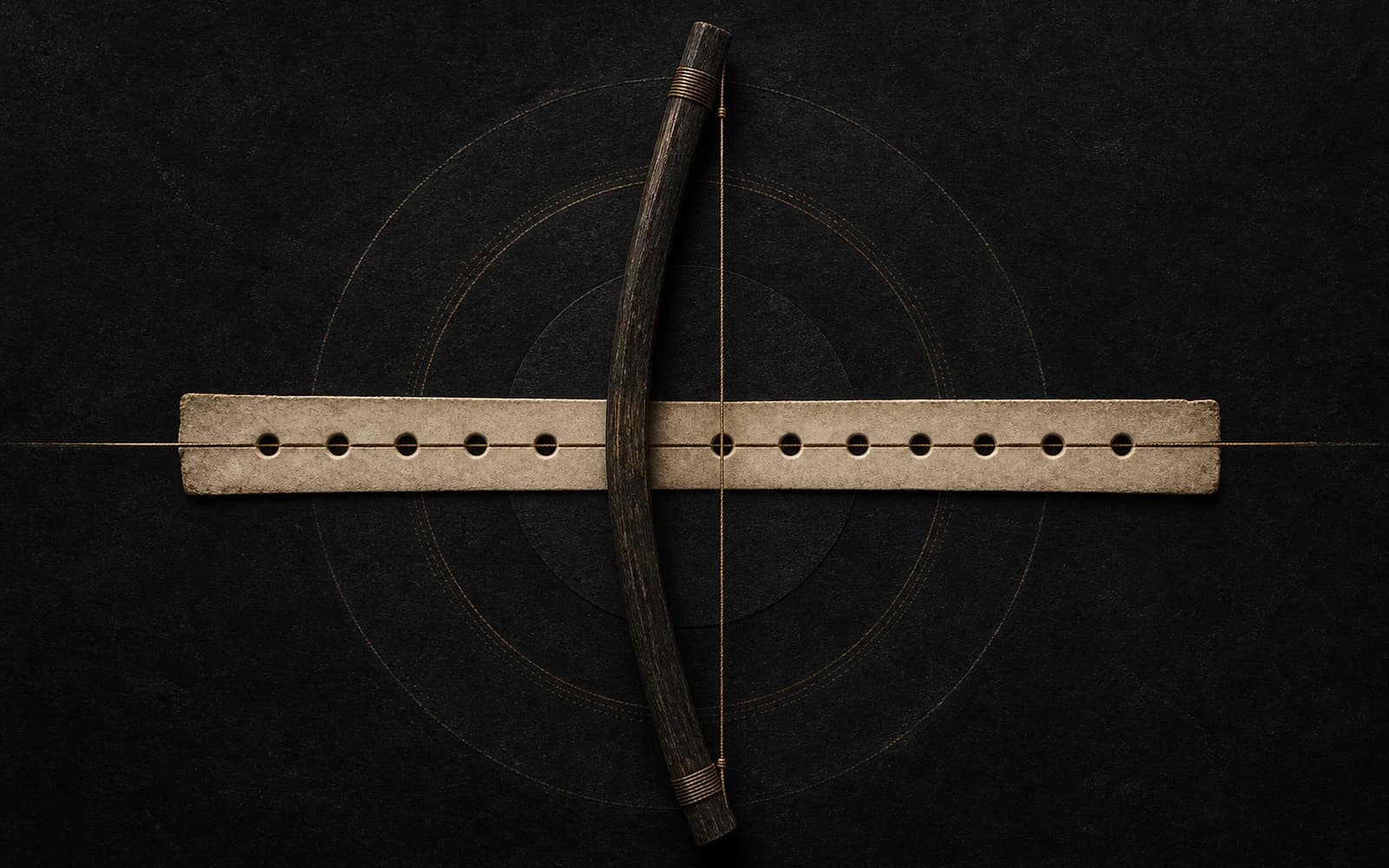
In Book 21 of the Odyssey, Penelope brings out Odysseus's bow and announces that she will marry whoever can string it and shoot through twelve aligned axe heads. Telemachus nearly succeeds, but stops at his father's signal. The suitors who attempt the test fail; Antinous postpones his own attempt. After Eumaeus and Philoetius pledge loyalty, the disguised Odysseus strings the bow easily and sends an arrow cleanly through the axes.
One more turn on the long way home.
Each book and episode changes the route, but the pressure is always the same: how to keep Ithaca from becoming only a memory.
Updated July 13, 2026
Four things to hold onto
- Penelope turns Odysseus's own weapon into the test that ends the suitors' occupation.
- Telemachus nearly strings the bow and then yields the decisive act to his father.
- Eumaeus and Philoetius learn Odysseus's identity and secure the doors before the shot.
- The bow functions as practical weapon, proof of identity, and symbol of household authority.
Book 21 converts twenty years of absence into a physical question: who can handle the object that belonged to the missing king? Penelope's contest appears to offer the household to a new husband. In practice, it places Odysseus's bow in Odysseus's hands while the suitors have been separated from the weapons that once hung on the walls.
The sequence is satisfying because it works on several levels at once. It is a contest, a recognition test, a transfer of authority, and the final tactical step before battle. The action follows directly from the gathering omens of Book 20; the book-by-book summary shows where it sits in the full return.
Penelope retrieves the bow
Athena prompts Penelope to set the contest. She goes to the storeroom where the bow and iron axes are kept, unlocks the doors, and weeps as she takes the weapon down. Homer supplies its history: the bow came from Iphitus, a guest-friend Odysseus met before the Trojan War. It belongs to a world of reciprocal gifts and remembered relationships, the opposite of the suitors' consumption without return.
Penelope enters the hall and states the terms. She will leave with the man who can string the bow and shoot through twelve axes. The task is not simply a strength test. A bow must be understood, flexed, and strung without breaking it. The shot also demands alignment and precision.
Whether Penelope consciously expects the stranger to win remains debatable. The poem gives her reasons for hope but withholds certainty. What is clear is that her decision brings the crisis to a point from which nobody can retreat.
Telemachus nearly completes the test
Telemachus sets up the axes with surprising competence and asks to try first. His participation makes sense: if he can string his father's bow, he may be able to prevent his mother from being taken away and prove that the household has an adult defender.
He fails three times. On the fourth, he is close enough that the poem suggests success is possible. Odysseus signals him, and Telemachus stops, joking that youth or weakness has defeated him. The moment does not humiliate him. It marks succession without replacement. The son has grown toward the father, but the absent king must perform his own return.
Telemachus then supervises the suitors' attempts. His control of the procedure contrasts with the powerless young man at the first assembly.
The suitors fail
Leodes, a ritual official among the suitors, tries first and cannot bend the bow. Antinous proposes warming and greasing it. One after another, the men struggle with the weapon whose owner's household they intend to inherit.
The failure exposes more than weak arms. The suitors have treated kingship as property available through Penelope's marriage: eat the estate, win the widow, occupy the seat. The bow reveals that authority is also embodied knowledge. They possess the hall but cannot operate its defining object.
Antinous delays his own attempt by invoking a festival of Apollo, god of archery. He proposes sacrifice and another try the following day. The irony is severe: ritual language becomes a way to postpone the proof that none of them matches the man they have declared dead.
For the object's larger meaning, see what Odysseus's bow symbolizes. In this scene, symbolism never replaces function. The bow is about to become a lethal weapon.
Odysseus reveals himself to two servants
Outside the hall, Odysseus tests Eumaeus and Philoetius one last time. He asks whether they would support their old master if he suddenly returned. Both answer with loyalty. Odysseus shows the scar on his thigh as proof.
He gives exact orders. Philoetius must lock the courtyard gate. Eumaeus must bring the bow and tell the women to secure themselves upstairs. These instructions matter as much as the contest: the coming fight is possible because exits, information, and weapons have been controlled.
The recognition is deliberately less emotional than those involving Telemachus, Eurycleia, or Penelope. It turns fidelity into assigned work. The servants know him because he provides proof; they serve him by taking risks that make the plan real.
The beggar asks for a turn
Back inside, Odysseus asks to test the bow. The suitors react with fear disguised as contempt. Antinous warns that wine has made the beggar arrogant. Penelope argues that allowing the attempt costs them nothing and promises the stranger gifts rather than marriage if he succeeds.
Telemachus intervenes and tells his mother that the bow is his concern. He sends her upstairs. Modern readers may hear the command as harsh, but within the plot it removes Penelope from the hall before the doors close and the attack begins. She does not witness the slaughter that her contest enables.
Eumaeus carries the bow to Odysseus despite the suitors' threats. Eurycleia shuts the women's doors, and Philoetius fastens the courtyard gate. The apparently comic request of a beggar has become an operation.
Odysseus strings the bow
Odysseus examines the bow like a skilled musician checking an instrument. He strings it without strain and plucks the cord; it gives a clear note. Zeus answers with thunder. The suitors' color changes because the action has communicated what the disguise still conceals.
Odysseus takes an arrow and shoots through all twelve axes. He then tells Telemachus that the guest has not disgraced him and that it is time to prepare the suitors' meal in another sense. Telemachus takes his sword and spear and stands beside him.
The full mechanics and symbolism of the scene are explored in the bow contest explained. As a Book 21 ending, the shot is a threshold. No explicit name has yet been announced to the room, and no suitor has yet died. But the skill the hall has just witnessed makes the identity unmistakable to the reader.
Book 22 begins with the bow still in Odysseus's hands. The contest was never separate from the reckoning. Penelope's test has selected her husband, restored the king's weapon, and trapped the men who could not recognize either one.
Classics RediscoveredThe Odyssey Companion
We make the classics readable for modern adults. Independent and unofficial — every quotation is checkable by book number against Homer's text. Questions? hello@odysseycompanion.com
Free reading preview
Take the route, names, and recognition scenes with you.
Get the one-evening guide and a designed preview from the complete edition. Useful on its own; clear about where to go next.
Questions people ask
What is Penelope's bow contest?
The suitors must string Odysseus's difficult bow and shoot an arrow through twelve aligned axe heads. Penelope says she will marry the man who completes the feat, but only Odysseus can do it.
Why does Telemachus stop trying to string the bow?
On his fourth attempt he appears close to succeeding, but Odysseus signals him to stop. Telemachus has demonstrated his growth; the final proof must belong to the returning owner of the bow.
Keep reading
The Odyssey Book-by-Book Summary
A clear 24-book summary of Homer's Odyssey: Telemachus, Odysseus' wanderings, the return to Ithaca, and the ending.
Read →
The Bow Contest in The Odyssey, Explained
How Penelope sets the bow contest, why the suitors fail, how Odysseus strings his weapon, and why recognition turns into revenge.
Read →
How Does The Odyssey End? The Ending Explained
How the Odyssey ends, step by step: the disguised return, the contest of the bow, the killing of the suitors, Penelope's bed test, and the final truce.
Read →
What Does Odysseus's Bow Symbolize?
Odysseus's bow joins physical identity, household authority, marriage, memory, and judgment in the Odyssey's final contest.
Read →
The Odyssey Book 22 Summary: The Killing of the Suitors
A clear Book 22 summary of the hall battle, the deaths of Antinous and Eurymachus, the loyal servants, and the episode's severe punishments.
Read →