The proof of return
Penelope's Pin in the Movie vs. Homer's Bed Test
The short answer
The film replaces Homer's olive-tree bed test with a portable Athena object used in the recognition between Penelope and Odysseus. In Odyssey Book 23, Penelope orders their bed moved, knowing it cannot be moved because Odysseus built it around a rooted olive tree. His angry technical description proves shared knowledge, while the movie's object makes recognition faster and more visible.
Objects remember what disguises hide.
Scar, bow, bed, pin, and household detail make identity visible through signs another person can test.
Updated August 1, 2026
Four things to hold onto
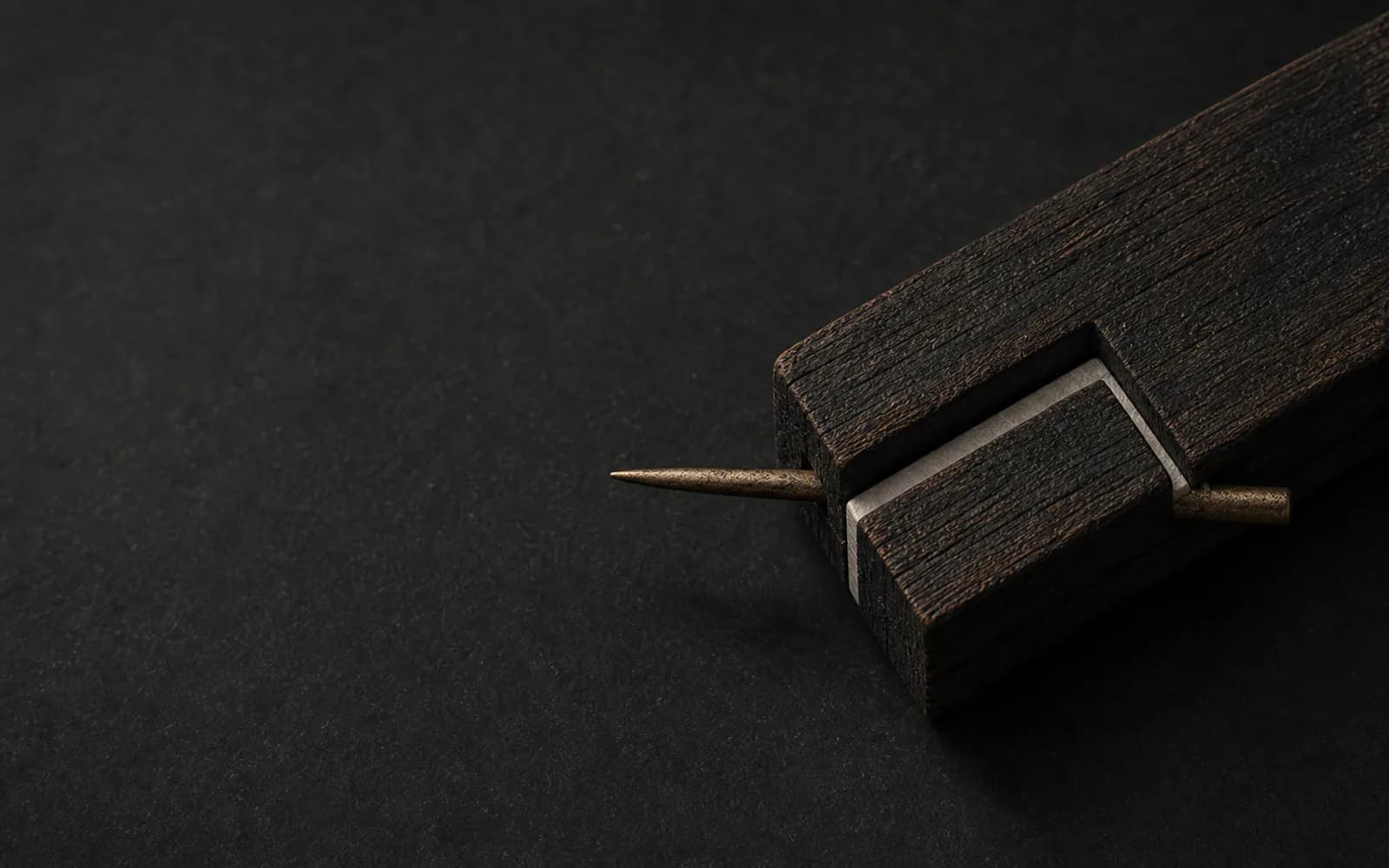
- The movie uses an Athena pin or figurine as recognition evidence.
- Homer's Penelope provokes Odysseus by ordering their immovable bed moved.
- The bed is built around a living olive trunk and encodes the marriage's history.
- The poem makes recognition a mutual test of intelligence, not passive acceptance.
The film's Athena object and Homer's olive-tree bed perform the same basic job: they establish that the returned man possesses private knowledge. But they do not make Penelope's recognition mean the same thing.
A pin or figurine can be displayed. The bed cannot be separated from the house without being destroyed. Homer therefore makes identity depend on a shared structure built into the center of married life.
What the movie uses
TheWrap's post-release ending explanation describes an Athena pin connected to Penelope's way of testing reports and to the final recognition. The Guardian likewise notes that the film substitutes an Athena figurine for the bed test.
Those reports support the claim that the released film uses a portable object. They should not be expanded into dialogue or motives not established by the scene. The important formal fact is portability: an item can move between people and become evidence in a compact cinematic exchange.
The object also connects recognition to Athena, the guiding presence the film has concentrated around Odysseus. In Homer, Athena helps prepare the return, but the decisive knowledge in Book 23 belongs to husband and wife.
How the bed test begins
After the suitors are dead, Eurycleia tells Penelope that Odysseus has returned. Penelope remains cautious. The man has changed in appearance, and the poem has trained everyone to distrust surfaces.
When they finally face each other, Penelope instructs Eurycleia to prepare the bed outside the bedroom. This sounds like a domestic order. It is actually a provocation.
Odysseus reacts immediately. He asks who has moved his bed and explains how he built the room around an olive tree. He cut and shaped the trunk into a bedpost, constructed the chamber around it, and completed the bed with careful craft.
Penelope now knows. The knowledge is too specific to be borrowed, and his emotional response shows that the object is not merely technical.
Why the olive tree matters
The bed joins nature, labor, architecture, sexuality, and memory. It begins as a living tree rooted in Ithacan ground. Odysseus transforms it without uprooting it. The marriage bed is therefore both made and grown.
It also cannot travel. Much of the poem follows a man who changes names, clothes, stories, and locations. The bed is the opposite: fixed, private, and structurally integrated with home.
This is why the olive-tree bed test is more than a password. Odysseus does not recite a secret phrase calmly. He reveals himself through knowledge, craft, anger, and attachment.
The larger portrait of Penelope shows why her caution is political judgment, not an artificial delay before reunion.
Penelope is the author of the recognition
The test restores Penelope's agency after a battle dominated by male violence. She does not accept identity because Eurycleia, Telemachus, or the bodies of the suitors tell her to. She creates a situation in which the claimant must disclose himself.
Odysseus is often celebrated for testing others while disguised. Penelope now tests the tester. Her method resembles his: indirect language, controlled information, and a trap whose purpose becomes clear only after it works.
The scene is mutual. His response proves who he is; her test proves she is still the intellectual partner he left behind.
What changes with a portable object
The movie's Athena object makes recognition visually economical. An audience can see it, remember it, and understand its evidentiary role quickly. It can also thread through earlier scenes, giving the film a repeated prop rather than introducing a detailed construction history near the end.
The cost is spatial. A portable token proves possession or continuity, but the Homeric bed proves belonging to a particular built world. One can carry a pin into exile. One cannot carry the rooted bed.
That difference becomes especially important because post-release reporting says the film sends Odysseus and Penelope away from Ithaca. The object can accompany a continuing voyage; Homer's bed marks the successful end of wandering.
Which version is stronger?
The answer depends on the adaptation's goal. The film needs a legible recognition device inside a compressed ending. The pin or figurine can connect multiple plot lines and survive a new final voyage.
Homer is doing something slower and more domestic. He asks whether two people can recognize the shared life that war and twenty years have almost erased. The bed answers because it is not only evidence of identity. It is the material form of the marriage they must inhabit again.
The most revealing comparison is therefore not object versus object. It is mobility versus rootedness. The movie chooses a sign that can travel. The poem chooses a structure that means the journey has finally stopped.
Classics RediscoveredThe Odyssey Companion
We make the classics readable for modern adults. Independent and unofficial — every quotation is checkable by book number against Homer's text. Questions? hello@odysseycompanion.com
Continue the reading
This is one part of the route. Keep the complete edition together.
The Home Pack combines the designed Odyssey in PDF and EPUB with the map, notes, cards, essays, and book-by-book reading path.
See the complete edition · $19Questions people ask
What does the Athena pin mean in the movie?
Post-release explanation identifies it as a private recognition object connected to Penelope's testing of information and Odysseus' eventual proof of identity.
What is Penelope's bed test in Homer?
She tells a servant to move the marital bed. Odysseus reacts because he built it around a rooted olive tree and knows it cannot be moved without destroying it.
Why does Penelope still test him after the suitors are dead?
Appearance, violence, and testimony are not enough in a poem full of disguises. She seeks knowledge that belongs specifically to their shared household.
Keep reading
The Odyssey Movie Ending Explained (vs. the Poem)
The Odyssey movie ending, explained: the pin that replaces the bed test, Telemachus crowned, the exile Nolan chose instead of Homer's truce — checked against the poem.
Read →
Penelope's Bed Test in The Odyssey, Explained
How Penelope tests Odysseus with their immovable olive-tree bed, why he reacts, and how shared knowledge completes the homecoming.
Read →
Who Is Penelope? The Odyssey's Other Strategist
Penelope in the Odyssey, explained: the weaving trick, the bow contest, and the bed test — why Homer's queen of Ithaca is a strategist, not a waiting wife.
Read →
Penelope and the Intelligence of Staying
Penelope in the Odyssey explained as strategy, sovereignty, memory, and the intelligence required to hold a home under pressure.
Read →